Is Wearable Art Considered Fine Art? What Separates It
Last Updated: November 7, 2026
Quick Summary
Wearable art is considered fine art when the piece is made as an artwork first and a garment second, with intention, originality, and presentation deciding the category rather than whether it has a sleeve. Museums like the Metropolitan Museum of Art's Costume Institute collect and exhibit garments as art, which undercuts the idea that art must hang on a wall.
- Wearable art differs from fashion, craft, and costume because the artist's concept leads every other decision.
- Classify a piece by asking what led the process, how many exist, who authored it, and where it has been shown.
- Curators evaluate wearable work on concept, craftsmanship, provenance, condition, and display viability.
- A numbered edition, a signature, or a documented source artwork signals fine-art intent rather than inventory.
- Start with one statement accessory like a scarf or cuff to try the category with low risk.
Table of Contents
- The Case for Wearable Art as Fine Art
- How Wearable Art Differs from Fashion, Craft, and Costume
- Wearable Art Examples That Settle the Question
- Wearable Art Clothing You Can Actually Wear
- How Wearable Art Designers Signal Artistic Intent
- Wearable Art Jewelry and the Body as Canvas
- How Museums and Curators Evaluate Wearable Work
- Collecting Wearable Art from Alana Kay Art
- Frequently Asked Questions
The Case for Wearable Art as Fine Art
Is wearable art considered fine art? The answer is yes, when the piece is made as an artwork first and a garment second. The question of whether wearable art counts as fine art turns on intention, originality, and how the work is presented, not on whether it happens to have a sleeve.
This guide breaks down that distinction. Below, we'll show you how curators, collectors, and artists draw the line, and what it means when you buy a piece.
The core argument is simple. Fine art is judged by concept and craft, not by medium. When concept and craft give a wearable object the force of fine art, the same questions of vision and execution shape how figurative work is valued at Annette Back Fine Art.
Where the Definition Gets Contested
Most of the disagreement comes from one assumption: that art must hang on a wall to count. That view treats clothing as utility and art as decoration, two separate worlds.
But the Metropolitan Museum of Art's Costume Institute collects and exhibits garments as art, which undercuts that split. Museums do not shelve these pieces with housewares.
The real test is intent. A mass-produced blouse is designed to sell in volume. A wearable artwork is designed to carry a concept, often in a limited run. That gap is where the argument settles.
How Wearable Art Differs from Fashion, Craft, and Costume
Wearable art differs from fashion, craft, and costume in its purpose. Fashion follows trends and reproduces designs at scale. Craft prizes technique. Costume serves a role or a story. Wearable art puts the artist's concept first and treats the body as the display surface.
The four categories overlap, and that overlap confuses people. A hand-sewn dress can be craft. A runway piece can be fashion and art at once. The label depends on what leads the process.
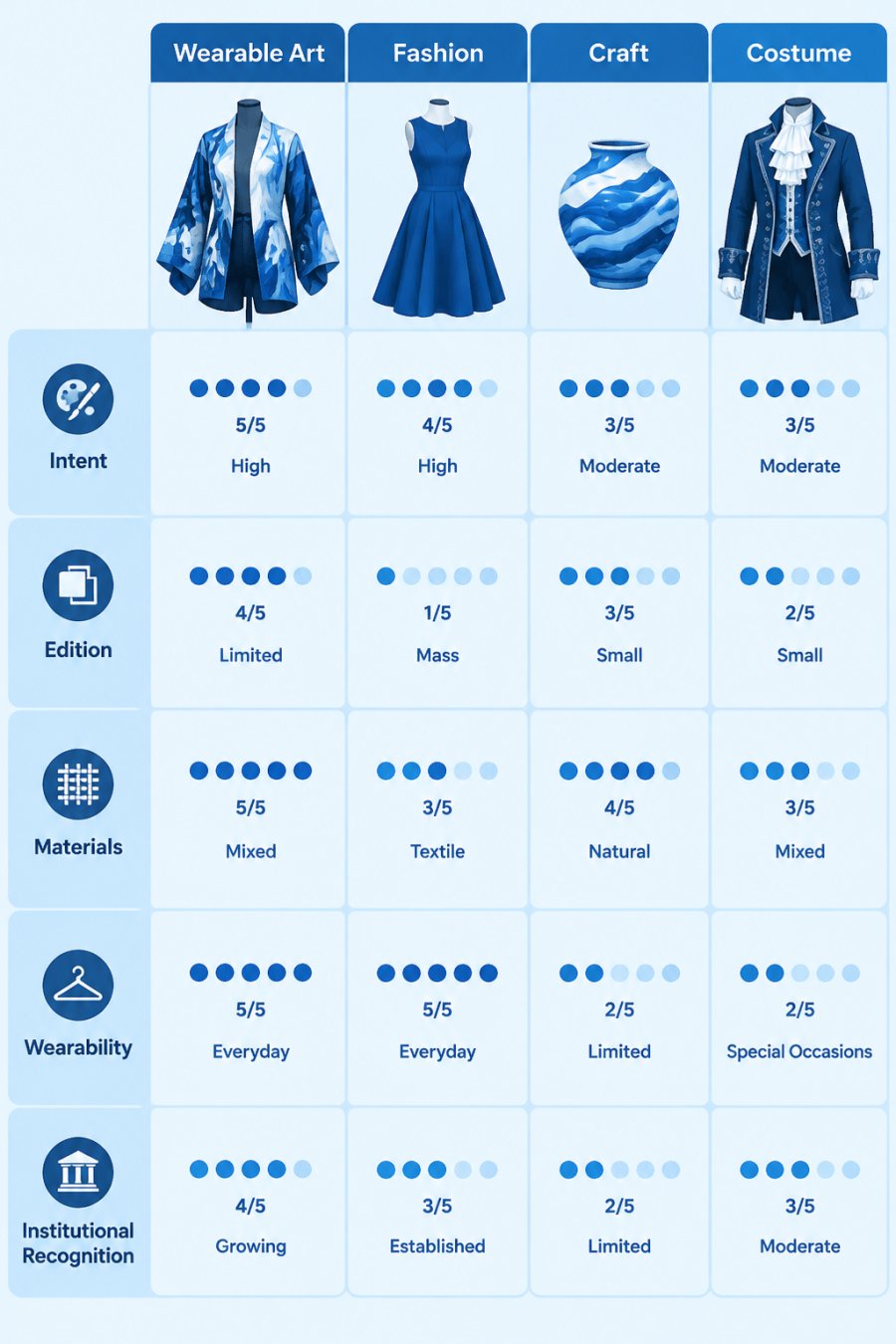
A Side-by-Side Comparison
| Trait | Wearable Art | Fashion | Craft | Costume |
|---|---|---|---|---|
| Primary intent | Artistic concept | Commercial trend | Technique | Character or role |
| Production | One-of-a-kind or limited | Mass or seasonal | Small batch | Production or rental |
| Materials | Chosen for expression | Chosen for cost and fit | Chosen for skill | Chosen for effect |
| Where it lives | Gallery, collection, wardrobe | Retail floor | Market or studio | Stage or screen |
The table shows the split clearly. Wearable art sits closest to fine art because originality and artistic intention lead every other decision.
How to Classify a Specific Piece
Most people do not need a definition. They need a way to sort one object. A practical test is to ask four questions in order:
- What led the process? If a concept or an original artwork came first and the garment was built around it, the piece leans toward wearable art. If a trend forecast or a sales plan came first, it leans toward fashion.
- How many exist? A numbered edition, a signed run, or a one-of-a-kind piece signals artistic intent. An open-ended restock signals commercial production.
- Who is the author? A named artist or designer with a documented body of work is a stronger signal than an anonymous label.
- Where has it been shown? Gallery, museum, or curated exhibition history strengthens the case. A retail catalog alone does not.
A piece does not have to pass all four to count. It has to pass enough of them that the artistic intent is the dominant reason it exists.
Where the Categories Overlap
A couture gown can be fashion and wearable art at once. A hand-knit sweater can be craft and wearable art. A theatrical costume can be designed by an artist with full creative control. The categories are not sealed boxes; they are weights on a scale.
The useful question is not "which box does this fit" but "what is the primary reason this object was made." When the answer is the artist's idea, the piece belongs in the wearable art conversation, whatever else it also is.
Watch out: sellers sometimes use "wearable art" as a marketing label for ordinary printed apparel. The four-question test above is the fastest way to tell the difference before you spend money.
Wearable Art Examples That Settle the Question
The strongest wearable art examples come from artists who treat the body as a canvas. Think sculptural dresses with rigid forms, headpieces built like architecture, and jewelry that reads as small sculpture.
These pieces are not made to blend in. They are made to be seen, discussed, and collected. That is the same standard applied to any work in a gallery.
If you want to see what that looks like in practice, you can browse the full art collection and judge the work yourself.
Wearable Art Clothing You Can Actually Wear
A statement coat is the easiest entry point. Our Penny Deluxe Wild Horses Faux Fur Trim Coat shows how a bold print and trim turn outerwear into a moving artwork.

- Check the fiber content before you buy
- Confirm care instructions match your routine
- Ask whether the print is limited or restocked
How Wearable Art Designers Signal Artistic Intent
Wearable art designers signal intent through documentation, edition size, and presentation. A designer who numbers a run, signs the piece, or explains the concept is telling you this is art, not inventory.
The creative process is the proof. When a print starts as an original painting or a commissioned illustration, the garment inherits that origin. Our own creative process and intent follows exactly that path.
What most shoppers miss is the paper trail. A designer who can name the source artwork, the print method, and the run size is signaling fine-art intent.
Wearable Art Jewelry and the Body as Canvas
Wearable art jewelry treats the body as a canvas at the smallest scale. A cuff, a pendant, or a scarf becomes a sculptural form that moves with you.
Accessories are the lowest-risk way to try the category. A single bold piece changes an entire outfit without demanding a full commitment.
Our handmade Wild Rag Scarf Square in silk and cotton works this way. It is a square of printed art you tie, drape, or knot, and it comes boxed and ready to gift.

- Start with one statement accessory
- Pair it with neutral basics
- Let the piece be the focal point
How Museums and Curators Evaluate Wearable Work
Museums and curators evaluate wearable work on concept, craftsmanship, provenance, condition, and display viability. A piece earns a collection slot when it tells a story beyond its function, survives the test of care, and can be shown without being destroyed by the showing.
That last point is where wearable art differs from a painting. A canvas can hang under glass for a century. A garment has to be mounted, supported, and protected from its own weight. Curators weigh those constraints before they weigh the artist's reputation.
The Criteria Curators Actually Apply
Most institutional reviews follow a similar sequence, even when the paperwork differs:
- Artistic intent and concept. Does the piece advance an idea, or does it decorate a body? Curators look for a body of work, not a single striking object.
- Originality and authorship. Who conceived it, who made it, and is the attribution clear? A piece designed by one hand and sewn by another can still qualify, but the record has to say so.
- Craftsmanship and material integrity. Are the seams, closures, and surface treatments built to last, or built for one season? Fragile construction limits exhibition life.
- Provenance. Who owned it, when, and how did it reach the market? A documented exhibition history or a named collector strengthens the case.
- Condition. Stains, fading, insect damage, and altered hems all reduce a piece's eligibility. Textiles age faster than most media.
- Display viability. Can it be mounted on a form, lit safely, and stored flat or padded between shows? If not, it may be declined regardless of merit.
A common pattern is that curators apply these tests to decide whether a piece belongs in a collection, not to settle a philosophical question. Institutional recognition is a signal, not a verdict.
What Institutional Recognition Does and Does Not Prove
When the Metropolitan Museum of Art's Costume Institute collects and exhibits garments, it is making a curatorial judgment about cultural and artistic significance. That judgment carries weight because it is backed by research, conservation resources, and a permanent collection. It does not create a universal standard that every wearable piece must meet.
A piece can be fine art in a private collection and never enter a museum. A piece can enter a museum and still be debated by critics. The institution is one voice in a longer conversation.
Where Care Becomes Part of the Evaluation
Condition is not a footnote. It is one of the reasons wearable art is harder to collect than flatwork. Dry-clean-only silks, structured shoulders, and beaded surfaces need careful handling. The Smithsonian's care guidance for textiles is a useful reference for anyone storing a collectible garment, and curators routinely consult the same standards.
Collecting Wearable Art from Alana Kay Art
Collecting wearable art means buying with the same eye you would bring to a painting. You look for originality, limited runs, and a clear artist behind the work.
At Alana Kay Art, every piece starts with original artwork and commissioned illustrations. Our collections are limited edition, so a print you love may not return.
If you want more guidance before you commit, read our guide on where to buy unique colorful clothing. It walks through how to spot real artistry versus a trend.
Watch out: limited runs sell through. If a piece speaks to you, do not wait.
The hardest part of collecting wearable art is trusting your own eye over the label on the rack.
Frequently Asked Questions
Is wearable art considered fine art?
Yes, when it meets the same tests applied to any other medium: original concept, evident artistic intention, craftsmanship, and a life beyond the body. Museums and curators treat wearable art as fine art when the piece is one-of-a-kind or a documented limited edition and is presented as an artwork rather than a product. The label depends on intent and context, not on whether the piece has sleeves.
What is the difference between wearable art and fashion?
Fashion is designed for a market and produced in runs that repeat season after season. Wearable art starts from an artistic concept and is made once or in a small edition, so the design itself is the artwork. A useful test: if the same garment could be reordered in any size next year, it is fashion. If the print, cut, or construction exists because of an artist's decision and will not be repeated, it sits in wearable art territory.
What are some examples of wearable art?
Well-known wearable art examples include sculptural dresses shown in museum exhibitions, hand-painted silk scarves, one-off constructed jackets, and art jewelry made from unconventional materials. At retail scale, limited-edition pieces such as a reversible satin bomber jacket or a handmade silk-cotton wild rag scarf carry the same logic: an original artwork translated into a garment and produced in a limited run.
Can wearable art be worn every day?
It can, and many collectors do wear their pieces regularly. The practical limits are care and construction rather than the art label. Check the fiber content and cleaning instructions before you buy, since each piece lists its own care requirements.

Leave a comment