
Modern Art vs Traditional Decor for Living Rooms
Last Updated: November 16, 2026
Quick Summary
Modern art delivers instant energy and a focal point, while traditional decor delivers warmth and a settled, timeless feel. Most homeowners don't need to pick a side: the strongest living rooms blend both by letting one style lead and the other support. Keep your traditional furniture and let a single bold modern art piece do the talking.
- Modern art is built on abstraction, bold color, and clean lines rather than realistic representation.
- Pair traditional furniture with contemporary art by contrasting texture, not just color.
- Art should span roughly two-thirds to three-quarters of the furniture width below it.
- Center artwork at eye level, about 57 to 60 inches from the floor, with 6 to 10 inches above furniture.
- Original paintings range from $900 for a 20 x 20 inch resin piece to $4,800 for a large framed statement piece.
Table of Contents
- Modern Art vs Traditional Decor: A Side-by-Side Comparison
- Modern Traditional Living Room Ideas That Actually Work
- Pairing Traditional Furniture with Contemporary Artwork
- Give Your Traditional Living Room a Modern Twist
- Traditional Living Room Ideas for Small Spaces
- What Modern Art vs Traditional Decor for Living Rooms Pictures Reveal
- Sizing, Hanging Height, and Budget: Practical Rules for Mixing Styles
- Find Your Statement Piece at Alana Kay Art
- Frequently Asked Questions
Modern Art vs Traditional Decor: A Side-by-Side Comparison
Choosing between modern art and traditional decor for a living room comes down to one trade-off: modern art delivers instant energy and a focal point, while traditional decor delivers warmth and a settled, timeless feel. Most homeowners don't need to pick a side, though. The strongest living rooms blend both.
Below, we'll show you exactly how to mix the two without the room feeling confused, starting with a clear-eyed comparison.
Key Aesthetic Differences at a Glance
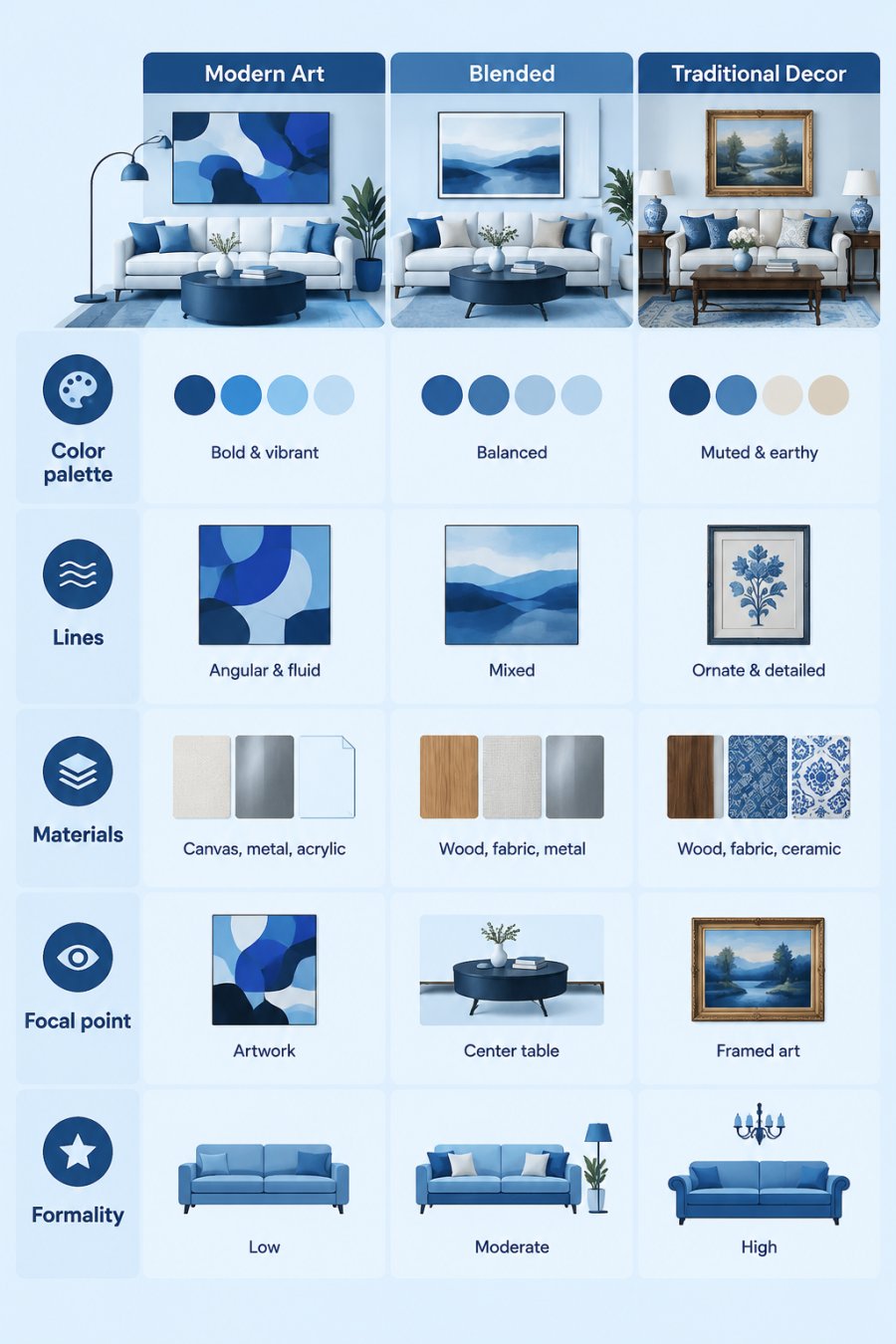
Modern art is artwork built on abstraction, bold color, and clean lines rather than realistic representation. Traditional decor is a furnishing style defined by dark wood, symmetry, rich fabrics, and layered detail.
The table below lays out how each approach shapes a living room.
| Criterion | Modern Art | Traditional Decor | Blended Approach |
|---|---|---|---|
| Color palette | Bold, saturated, abstract | Warm, earthy, muted | One bold piece against warm walls |
| Lines | Clean, simple, open | Ornate, carved, detailed | Simple art, detailed furniture |
| Materials | Resin, acrylic, wood panel | Dark wood, velvet, oak | Glossy art near matte upholstery |
| Focal point | Single statement piece | Layered gallery wall | One large piece, small accents |
| Formality | Relaxed, casual | Formal, structured | Formal bones, relaxed art |
Pros and Cons of Each Style
Each style solves a different problem, and each has a real limitation worth knowing before you commit.
** Modern art cons: A bold abstract piece can overpower a room full of ornate furniture if the scale is wrong, and it offers less built-in "warmth" than layered traditional decor.
The honest answer for most people: keep the traditional furniture you love, then let one modern piece do the talking.
Modern Traditional Living Room Ideas That Actually Work
The most reliable modern traditional living room ideas follow one rule: let one style lead and the other support. A room with traditional bones (oak floors, a dark wood sofa frame, a classic rug) can carry a bold abstract painting without tipping into chaos, because the art is the only modern voice in the room.
Three approaches that hold up in practice:
- One statement piece over the sofa. A single large abstract anchors the seating area and gives the eye a resting point.
- Modern art against warm neutrals. Keep walls in cream or warm gray so the artwork's color does the work.
- Repeat one accent color. Pull a hue from the painting into a throw pillow or ceramic, and the two styles start to feel intentional.
A common mistake is adding modern art and modern furniture and a modern rug to a traditional room all at once. That doesn't blend styles, it replaces them. Pick one modern element and let it breathe.
Pairing Traditional Furniture with Contemporary Artwork
Pairing traditional furniture with contemporary artwork works best when you contrast texture, not just color.
Scale matters more than most guides admit. A small abstract floating above a heavy, tall traditional sofa looks lost.
For a concrete example, Iris - Original Abstract Painting is a 20 x 20 inch resin piece with flowing, vibrant color.

What most guides miss: the frame.
Give Your Traditional Living Room a Modern Twist
Giving a traditional living room a modern twist is mostly about subtraction and one confident addition. Clear one wall, remove a cluttered gallery arrangement, and let a single bold piece take its place. The room keeps its character but gains freshness.
Color is your fastest lever. If the room runs on browns, creams, and muted greens, a painting that bursts with lively color becomes the modern twist all by itself. Poppies - Original Abstract Painting does exactly this: a 20 x 20 inch resin piece with dynamic texture and joyful color that brightens a traditional space without a single new piece of furniture.
Keep the traditional anchors, the rug, the wood tones, the formal seating, and change only the art. That single swap is the lowest-risk way to modernize a room you already love.
Traditional Living Room Ideas for Small Spaces
Small traditional living rooms fail for a measurable reason: too many edges.
Start with the wall you actually have.
A few rules that hold up in tight rooms:
- Choose one medium-to-large piece over a cluster of small ones. A single 30 x 40 inch canvas replaces four 16 x 20 inch frames and removes three sets of edges. Fewer, bigger elements reduce visual noise.
- Hang art on the largest uninterrupted wall, not above every surface. A piece squeezed between a window and a doorway reads as clutter even when it is beautiful.
- Keep the palette tight. A monochromatic or two-tone abstract, like Enchanted Forest - Original Abstract Painting with its vibrant green tones, adds life without adding busyness.
- Skip heavy dark frames in a small room; a dark frame on a light wall draws a hard border and visually shrinks the wall. A thin float frame or a gallery-wrapped canvas keeps the edge soft.
- Respect the 57-to-60-inch rule. Center the art at roughly eye level, and leave 6 to 10 inches between the bottom of the frame and the sofa back. In a small room, hanging too high is the most common mistake because it pulls the eye up and makes the ceiling feel lower.
Traditional furniture can stay. It is the wall that needs breathing room, and the fastest way to give it breathing room is to remove one object rather than add one.

Watch out: in a small room, a very large piece can crowd the seating if it extends past the sofa on both sides.
What Modern Art vs Traditional Decor for Living Rooms Pictures Reveal
Here is what to look for when you study reference photos, and what to replicate in your own living room:
- Count the focal points. In a successful blend, exactly one object is the brightest or highest-contrast element in frame. If two objects tie for that role, the photo will feel unsettled even if you can't name why. In your room, decide which object wins before you hang anything.
- Check the value gap. A dark traditional sofa against a pale wall gives a bold abstract a quiet stage. If your walls and furniture are the same value (all mid-tone browns, for example), a saturated modern piece will feel louder than it did in the gallery.
- Compare sheen. Glossy resin or acrylic art reflects light and reads as "modern" even when the subject is traditional. Matte oil or canvas reads quieter. Photograph your wall at the time of day you use the room most; glare that looks dramatic in a listing photo can be a daily annoyance.
- Measure the art-to-furniture ratio in the photo. Most well-composed living room photos show art spanning roughly two-thirds to three-quarters of the sofa or console width. If the art in a reference photo looks small relative to the furniture, it will look small in your room too.
- Look at the negative space. Rooms that photograph well leave breathing room around the main piece, usually at least 6 to 10 inches between the bottom of the frame and the furniture below, and clear wall on either side.
A common pattern in listing and magazine photos is a traditional room with one large, bright abstract hung off-center over a sofa, with the fireplace left as a secondary anchor.
Watch out: photos are lit for the camera, not for daily life. A piece that looks balanced in a bright, staged photo can go flat in a north-facing room with one lamp. Check your room at night before you commit to a size or a frame finish.
Sizing, Hanging Height, and Budget: Practical Rules for Mixing Styles
Get the practical numbers right and the style question mostly solves itself. Here are the rules we'd give a friend.
Sizing: Art should span about two-thirds to three-quarters of the furniture width below it.
Hanging height: The center of the artwork should sit at eye level, roughly 57 to 60 inches from the floor.
Budget: Original art is a one-time purchase, not a subscription, so compare it to the cost of the furniture it sits above. Our originals range from $900 for a 20 x 20 inch resin painting to $4,800 for a large framed statement piece. Heaven Falls, Earth Rises - Original Abstract Painting with Custom Frame measures 49 x 39 inches with its frame and arrives ready to hang, which removes the framing cost and guesswork from the budget.
Watch out: buying art to match a paint color exactly usually backfires. Match the room's undertone, warm or cool, and let the art bring its own color.
Find Your Statement Piece at Alana Kay Art
The right piece ends the debate. Instead of choosing a camp, choose an artwork bold enough to hold a traditional room together and modern enough to wake it up.
Our original abstract paintings are made to be the focal point: resin and acrylic on wood panel, bold color, and real texture you can see across the room. Browse Enchanted Forest and Unbothered, both 20 x 20 inch originals at $900, or step up to the framed scale of Heaven Falls, Earth Rises for a true collector's piece.

Your living room doesn't need a full redesign to feel current. It needs one confident piece that bridges the traditional furniture you already own and the modern energy you want. Alana Kay Art offers original, limited-edition artwork built on bold color and thoughtful design, with pieces sized for real rooms and priced as collectible one-time buys.
Frequently Asked Questions
What is the difference between modern art and traditional decor in a living room?
Modern art leans on bold color, abstract forms, and clean lines, often using materials like resin or acrylic on wood panel. Traditional decor favors warm palettes, dark wood, ornate details, and layered patterns. In a living room, modern art acts as a focal point that breaks up traditional furnishings, while traditional decor provides grounding warmth. The key difference is visual weight: modern art draws the eye immediately, traditional decor builds atmosphere gradually through texture and repetition.
Can you mix modern art with traditional living room furniture?
Yes, and the contrast often makes both look better. A bold abstract painting above a dark wood console or a traditional sofa creates tension that reads as intentional. Keep the artwork's frame simple so it does not compete with ornate furniture, and repeat one color from the art in a throw pillow or rug to tie the room together. Scale matters: a 20 x 20 inch piece works above a sideboard, while a larger statement work suits a main wall.
How do you choose art for a traditional living room?
Start with the room's dominant palette. If your traditional living room uses warm neutrals, dark wood, and muted greens, a modern abstract with a similar base but bolder accents will feel cohesive. Hang the art so its center sits at eye level, roughly 57 to 60 inches from the floor. For a 20 x 20 inch piece, leave at least 8 to 10 inches of breathing room above furniture. Avoid matching every color in the room; one or two echoes are enough.
How do you make a traditional living room feel more modern?
Swap one traditional element for a modern counterpoint rather than replacing everything. Replace a heavy landscape print with a bold abstract painting, add a sleek floor lamp, or introduce a solid low-pile rug under patterned furniture. Keep the traditional bones (molding, dark wood, classic sofa) and let the modern piece do the work. Limiting yourself to one or two modern additions prevents the room from feeling disjointed.

Leave a comment