How to Style Bold Statement Apparel: 12 Easy Outfits
Table of Contents
- Why Bold Statement Apparel Feels Hard to Wear (And Why It Shouldn't)
- The 3-3-3 Rule: Your Foundation for Styling Bold Statement Apparel
- How to Style a Statement Shirt: 4 Foolproof Formulas
- Best Practices for Mixing Patterns Without Clashing
- Balancing Bold Pieces with Neutrals: The 80/20 Rule
- How to Wear Statement Apparel to Work (Without Looking Overdressed)
- Where to Buy Unique Colorful Clothing That Lasts
- Your Capsule Wardrobe Integration Plan
- Frequently Asked Questions
Last Updated: September 6, 2026
Bold statement apparel often sits unworn because it feels intimidating to style, yet the secret isn't confidence, it's strategy. This guide from Alana Kay Art breaks down the exact formulas to wear vibrant, artistic pieces with ease.
The most common mistake is treating a bold piece as an island. When you wear a patterned jacket or colorful coat, the rest of your look must ground the aesthetic.
Why Bold Statement Apparel Feels Hard to Wear (And Why It Shouldn't)
The hesitation usually stems from a fear of visual overload. Many women worry that a loud print or vivid color will draw unwanted attention or clash with their environment. In reality, the problem isn't the garment; it's the lack of a cohesive styling framework to anchor it.
Fashion psychology suggests that wearing clothes that express our identity boosts mood and self-perception (peer-reviewed research). The key is to remember that a statement piece is the hero, not the entire cast.
The 3-3-3 Rule: Your Foundation for Styling Bold Statement Apparel
To simplify the process, adopt the 3-3-3 Rule: one bold statement piece, three neutral or solid-colored items, and three accessories or less.
- One Statement Piece: This is your focal point, such as the Penny Deluxe Wild Horses Faux Fur Trim Coat or a vibrant printed dress.
- Three Neutral Staples: These are your supporting garments, like a black turtleneck, white wide-leg pants, or beige slacks. They provide a visual resting place for the eye.
- Three Accents: Limit yourself to a maximum of three accessories. This could be a pair of earrings, a belt, and a handbag. This constraint prevents the outfit from becoming too busy.
This rule works because it creates an instant color palette and visual hierarchy, keeping the focus on the statement piece.

How to Style a Statement Shirt: 4 Foolproof Formulas
A statement shirt is arguably the easiest bold piece to wear because it’s inherently casual. The answer lies in letting the top dictate the bottom. Here are four formulas that work every time:
- The Office Polish: Tuck a colorful printed blouse into high-waisted, solid-colored trousers. Add a pointed-toe heel and a structured tote. The tailored bottom grounds the artistic top.
- The Weekend Casual: Pair your statement shirt with classic blue jeans and white sneakers. Roll the sleeves for a relaxed feel. The denim adds a familiar texture that makes the shirt feel approachable.
- The Layered Look: Wear a bold shirt unbuttoned over a plain white tank top or camisole. This creates a vertical line that flatters the silhouette while breaking up the pattern.
- The Monochromatic Base: If your shirt has a dominant color, such as emerald green, wear bottoms in that exact shade. This creates a high-fashion, tonal look that feels intentional.
Best Practices for Mixing Patterns Without Clashing
Most guides stop at “vary the scale,” but the real skill is understanding why a combination works on your specific frame. The goal isn't just to avoid a clash; it's to use pattern placement to flatter your silhouette.
The Mechanism: Visual Weight and Focal Points
Patterns draw the eye. A large-scale floral print on a jacket makes shoulders appear broader; a bold geometric pattern on wide-leg pants adds visual width to hips and legs. This is a tool, not a problem, use it to create balance where you want it.
- For a straighter, athletic build: If you want to create the illusion of curves, place your boldest, largest-scale pattern on your lower half. A pair of high-waisted, wide-leg trousers in a vibrant abstract print will add volume and visual interest to your hips. Pair this with a solid, fitted top in a color pulled from the pants to keep the focus below the waist.
- For a pear-shaped or fuller hip build: Reverse the logic. Your goal is to draw the eye upward and balance your proportions. Wear your statement pattern on top, a printed blouse or a patterned jacket, and keep your bottom half in a solid, dark neutral. This creates a clear visual triangle, drawing the eye up to your face and shoulders.
- For a fuller bust or broad shoulders: Avoid large, busy patterns directly on your chest. Instead, choose a smaller-scale, tonal print for your top (like a fine polka dot or a subtle paisley in a dark color) and pair it with a solid bottom. If you want a bolder pattern, wear it on a long-line cardigan or open duster coat, which creates vertical lines that elongate the torso.
The 60-30-10 Color Rule for Patterns
A more precise method than “unify with color” is to apply the 60-30-10 rule to your patterned outfit, a classic interior design principle that works flawlessly for clothing.
- 60% Dominant Color: This is the base color of your outfit, usually from your solid pieces. For example, a pair of navy trousers and a navy knit top.
- 30% Secondary Color: This is the secondary color found in your main patterned piece. If your patterned jacket has navy, mustard, and cream, the mustard is likely your secondary color. Ensure this color appears in at least one other solid accessory, like a handbag or a belt.
- 10% Accent Color: This is the smallest, most vibrant color in your pattern. Use this for a single, small accessory, a pair of earrings, a scarf, or a pair of shoes. This creates a cohesive, designer-level look because it proves the pattern choice was intentional.
The “Pattern Bridge” Technique
When mixing two patterns, use a “pattern bridge”, a third item that shares a color or motif with both. For example, with a leopard-print skirt (black and tan) and a striped top (white and black), a black leather belt bridges the two.
A Practical Checklist for Your Body Type
Before you step out, run through this quick checklist:
- Identify the Focal Point: Where do you want the eye to land first? (e.g., face, waist, legs).
- Place the Largest Pattern There: The largest scale pattern should be on your chosen focal point.
- Check the Scale Ratio: Ensure your second pattern is at least 2-3 times smaller than your primary pattern.
- Confirm the Color Bridge: Verify that at least one color from your primary pattern appears in your secondary pattern or your solid base.
- Do the Spin Test: Look in a full-length mirror and spin. If your eye feels dizzy or you can't find a resting place, remove one pattern.
Balancing Bold Pieces with Neutrals: The 80/20 Rule
The most reliable method for wearing loud clothing is the 80/20 Rule: 80% of your outfit should be neutral-hued or solid-colored basics, while only 20% should be your bold, statement piece.
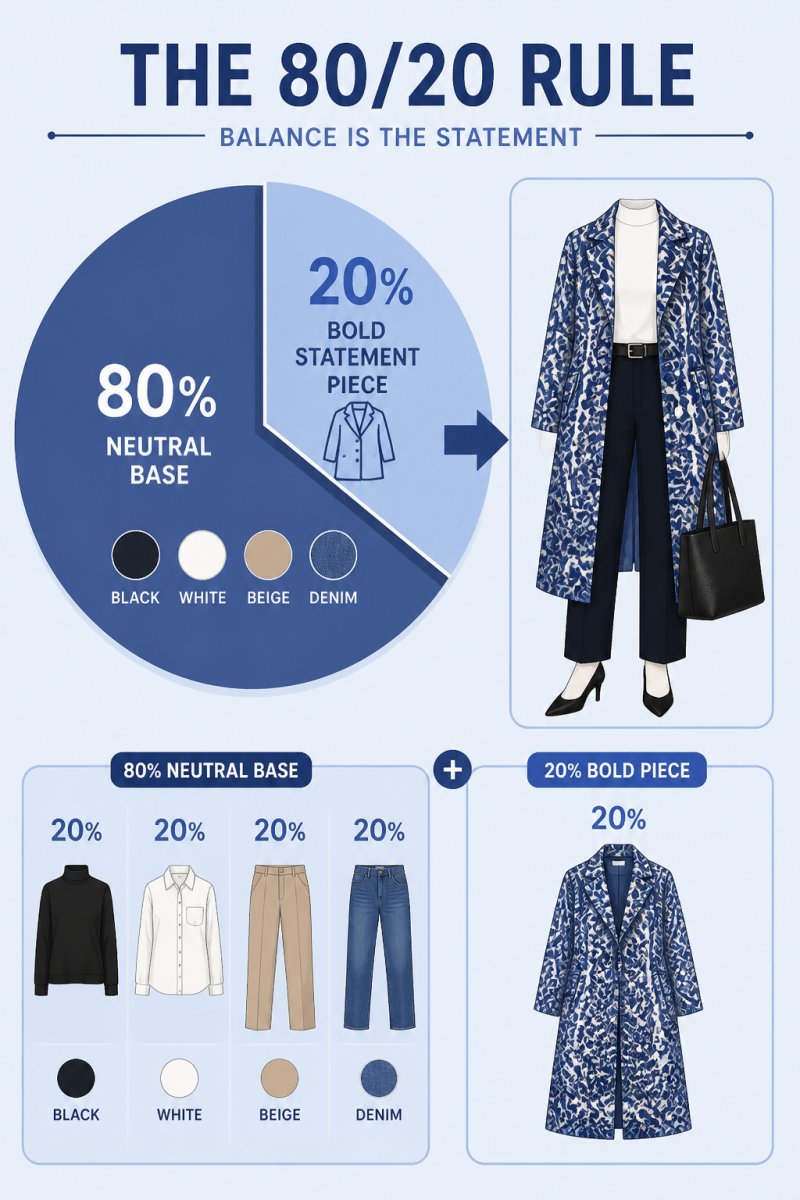
For example, with a vibrant, patterned cocktail dress, keep accessories, shoes, and outerwear minimal and solid-colored. If styling a colorful coat, wear an all-black or all-white base underneath.

This rule also applies to proportions. If wearing wide-leg pants with a bold print, pair them with a form-fitting, solid-colored top.
How to Wear Statement Apparel to Work (Without Looking Overdressed)
Wearing artistic pieces in a professional setting requires a shift in strategy. The goal is to let the bold piece read as "confident" rather than "casual," achieved by choosing statement items with formal structure, like a blazer or tailored coat.
To make it work, anchor your bold piece with corporate staples. If you wear a printed jacket, pair it with a crisp white shirt and tailored black trousers. Keep your makeup and hair sleek and minimal. The professionalism of the rest of the outfit elevates the art piece. According to guidelines on workplace attire, dressing appropriately is key to projecting competence.
Many professional women worry that a bold print will look unprofessional, but when styled correctly, it signals creativity and confidence. If hesitant, start small: wear a bold scarf or statement earrings with a standard suit, then graduate to a printed blazer.
Where to Buy Unique Colorful Clothing That Lasts
Finding bold pieces that don't fall apart after three washes is a real challenge. The fast-fashion market is built on low prices and quick trends, often meaning poor fabric quality and construction. But you don't need a high-end designer budget, the key is knowing where to look and what to inspect before you buy.
The Thrifting Strategy for Statement Pieces
Thrift stores and consignment shops are goldmines for unique, bold apparel because they carry items from past seasons you won't see on everyone else. Shop with a specific list to avoid feeling overwhelmed.
- Focus on Fabric: Before you look at the pattern, feel the fabric. Skip anything that feels like thin polyester or scratchy acrylic. Look for natural fibers like 100% silk, heavy-weight cotton, linen, or wool. A genuine vintage silk blouse with a loud print will last for decades and look far more luxurious than a new fast-fashion version.
- Check the Construction: Look inside the garment. Are the seams straight and finished? Is the garment fully lined? Are the buttons securely attached? These are signs of quality construction that will survive repeated wear and cleaning.
- Know Your Alteration Limits: A jacket that is slightly too big in the shoulders is a cheap fix at a tailor. A jacket that is too small in the shoulders is not. Learn which simple alterations (hemming pants, taking in a waist) are worth the $20-$40 tailor cost, and which fit issues are deal-breakers.
The DIY Embellishment Route
Another budget-friendly path is to buy a solid-colored, high-quality base garment and make it a statement piece yourself, giving you total control over the design and ensuring a perfect fit.
- Fabric Paint and Markers: Create a custom abstract design on a plain denim jacket or a canvas tote. Use textile-specific paints (available at craft stores like Michaels or JOANN) and follow the heat-setting instructions to make it washable.
- Hand Embroidery: Adding a simple embroidered motif, like a colorful flower or a geometric shape, to the collar or pocket of a plain shirt adds a unique, artisanal touch. Embroidery floss is inexpensive, and there are countless free tutorials on sites like YouTube to learn basic stitches.
- Hardware and Pins: Replacing standard buttons on a coat with vintage or decorative buttons instantly elevates the piece. Adding enamel pins or a unique brooch to a lapel is a zero-commitment way to inject personality.
What to Look For in New Purchases
When you do buy new, whether from an independent artist or a mid-range retailer, use this checklist to ensure longevity:
- Fabric Weight: Hold the garment up to the light. If you can see through it easily, it's likely too thin for regular wear.
- Colorfastness: Look for labels that say “colorfast” or “pre-shrunk.” For bright colors, especially reds and deep blues, check if the manufacturer recommends washing in cold water to prevent fading.
- Seam Allowance: Turn the garment inside out. A generous seam allowance (at least 5/8 of an inch) means you can let the garment out if needed, and it indicates a higher level of care in manufacturing.
- Care Label Realism: Be honest about how you launder clothes. If a piece says “dry clean only” and you know you will never take it to the dry cleaner, don't buy it. A bold piece that you can't maintain will end up unworn.
The Investment Math
A common pattern is buying three $40 fast-fashion statement tops that fall apart in a season versus one $120 well-made piece that lasts for years. The cost per wear of the higher-quality item is often lower, making it worth the higher upfront price.
Your Capsule Wardrobe Integration Plan
Integrating bold pieces into a capsule wardrobe is easier than you think. A capsule wardrobe relies on versatility, and a statement piece adds the personality that neutral basics lack. To integrate successfully, ensure your bold colors complement the existing color palette of your capsule.
Start by identifying the dominant colors in your statement piece. If your coat features blues and greens, ensure you own neutral bottoms in navy, grey, or cream, allowing the coat to pair with multiple outfits.
The goal is to create a collection where everything works together. As highlighted in minimalist style guides, having a clear color story makes dressing effortless. This approach ensures your bold item never sits unworn because you always know exactly what to pair with it.
Styling bold clothing is a skill that grows with practice, but the mental shift is the hardest part. Start by applying the 80/20 Rule to one outfit this week and notice how the balance changes your comfort level. Alana Kay Art creates limited-edition apparel designed to be worn and collected, crafted from original artwork to inspire confidence and individuality. Explore collections featuring original artwork and commissioned illustrations to find your next signature piece.
Frequently Asked Questions
What is the 3-3-3 rule for clothing?
The 3-3-3 rule is a wardrobe planning method: pick 3 tops, 3 bottoms, and 3 pairs of shoes, then mix them into 9 different outfits for the week. When styling bold statement apparel, apply this rule by making your statement piece one of the three items and keeping the other two neutral. This prevents outfit fatigue and ensures your artistic pieces get worn instead of hanging in the closet.
How do you balance a bold statement piece with the rest of your outfit?
Balance comes from contrast. Pair a heavily patterned or textured statement piece like a velvet wild-horses coat with simple, solid-colored basics underneath. Keep the rest of your outfit in neutral tones like black, white, cream, or denim. Limit yourself to one statement piece per outfit, and let your accessories stay minimal so the bold item remains the clear focal point.
Can you wear statement apparel to a professional setting?
Yes, with strategic styling. Choose one bold element, like a colorful printed blazer or dress, and anchor it with conservative pieces: a solid blouse, classic pumps, and minimal jewelry. Keep the silhouette professional and structured. A feather-trimmed cocktail dress works for evening events, while a printed coat reads as polished outerwear over a simple work dress or trousers.
What colors should you avoid pairing with bold prints?
Skip colors that directly compete with your print's palette. If your statement piece features warm tones like rust and gold, avoid cool-toned accessories that clash. Instead, pull one accent color directly from the print and echo it in your shoes or bag. When in doubt, black, white, cream, and denim always work as neutral anchors for colorful artistic pieces.
Leave a comment