
How to Resell Your High Quality Clothing for Top Dollar
Last Updated: October 29, 2026
Quick Summary
To learn how to resell your high quality clothing, start by identifying what buyers hunt for: bold prints, natural fibers, limited-edition designs, and clean construction. Then prepare each piece, photograph it in natural daylight, and price it from comparable sold listings rather than asking prices.
- Resale apps charge final value fees of roughly 8-20% plus payment processing.
- Consignment shops typically take a 40-60% commission split and suit designer pieces.
- Buyout services pay instant cash but offer only 20-40% of resale value.
- Set your asking price 10-20% above your walk-away number to leave room for offers.
- Re-evaluate stale listings after 30 days and adjust or relist them.
Table of Contents
- What Clothes Sell Best Online (and What to Skip)
- Choosing the Right Online Marketplace for Your Garments
- Preparing Your High Quality Clothing for Sale
- How to Photograph Clothes for Resale
- How to Price Used Clothes for Resale
- How to Write Clothing Listings That Sell
- Packaging, Shipping, and Managing Repeat Inventory
- List Your First Piece and Start Your Resale Closet
- Frequently Asked Questions
What Clothes Sell Best Online (and What to Skip)
The pieces that resell fastest are the ones buyers can't find anywhere else: statement outerwear, limited-run prints, and well-made natural-fiber basics. Browsing our apparel category helps readers recognize the kinds of quality garments that resell well. If you want to learn how to resell your high quality clothing, start by understanding what buyers actually hunt for.
Strong sellers share a few traits:
- Bold color and print that photographs well and stops a scroll
- Natural fibers like linen and cotton that hold value
- Limited-edition or artist-driven designs with a story
- Clean construction with intact seams and hardware
Skip the worn basics, stained knits, and anything with missing buttons.
Spotting Genuinely High-Quality Garments
High-quality clothing is defined by how it's made, not by the label. Check the fiber content tag, the seam finish, and the weight of the fabric in your hand.
Here's our quick test:
- Fabric feels substantial, not thin or scratchy
- Seams are finished, not raw or fraying
- Buttons and zippers work smoothly
- Lining is intact and stitched cleanly
- Care label lists real fibers, not mostly polyester
Choosing the Right Online Marketplace for Your Garments
Pick your platform based on garment type, your goal, and how much effort you're willing to put in. A resale marketplace works best for volume and speed, while consignment suits designer pieces that need a curated audience. The right choice depends on fees, payout speed, effort, and the kind of inventory you have.
Compare Selling Routes by Fees, Effort, and Payout Speed
| Route | Typical fee structure | Effort | Payout speed | Best for |
|---|---|---|---|---|
| Peer-to-peer resale apps | Final value fee roughly 8-20% plus payment processing | High: you photograph, list, answer questions, ship | Days to weeks after sale | Everyday wear, mid-price brands, volume sellers |
| Consignment shops | Commission split, often 40-60% to the shop | Low: you drop off, they sell | Weeks to months | Designer pieces, curated audiences, low-effort sellers |
| Buyout services | No seller fee, but lower offer (often 20-40% of resale value) | Very low: instant cash | Immediate | Quick closet cleanouts, items you don't want to manage |
| Direct social sales | No platform fee, but you handle payment and shipping | High: you market, negotiate, ship | Variable | Statement pieces with a following, unique or artist-driven designs |
Match the Channel to the Piece
- Resale apps: fast turnover for everyday wear and mid-price brands
- Consignment shops: higher payouts on designer labels that need a curated audience
- Buyout services: instant cash, lower return, best for items you don't want to manage
- Direct social sales: best for statement pieces with a following, where you can tell the story
For inspiration on where unique, colorful clothing sells best, our guide to where to buy unique colorful clothing: 9 best spots shows how curated pieces get discovered.
Preparing Your High Quality Clothing for Sale
Preparation decides your final price. Wash or dry-clean each piece, steam out wrinkles, and repair loose buttons before you list.
Follow this order:
- Check pockets and remove lint
- Repair minor seams and buttons
- Steam or press gently
- Store flat until photographing
Presenting garments well matters. Browsing our dresses collection shows how quality pieces are styled and cared for before they reach a buyer.
How to Photograph Clothes for Resale
Good photos are the single biggest driver of clicks. Shoot in natural daylight, use a plain background, and capture front, back, label, and any flaw.
Our photo checklist:
- Natural light near a window, no flash
- Wrinkle-free garment on a hanger or flat lay
- Close-up of fabric texture and stitching
- Clear shot of the size and brand tag
- Honest photo of any wear or flaw
A well-shot product page, like our Wild Rag Scarf Square - Silk Cotton, shows the detail and styling shots that make listings sell.
How to Price Used Clothes for Resale
Price from comparable sold listings, then adjust for condition, demand, and your target net payout. Research sold items, not asking prices, to find the real resale value. A common pattern among experienced sellers is to work backward from the payout they want rather than forward from a hopeful asking price.
Calculate Your Net Proceeds Before You List
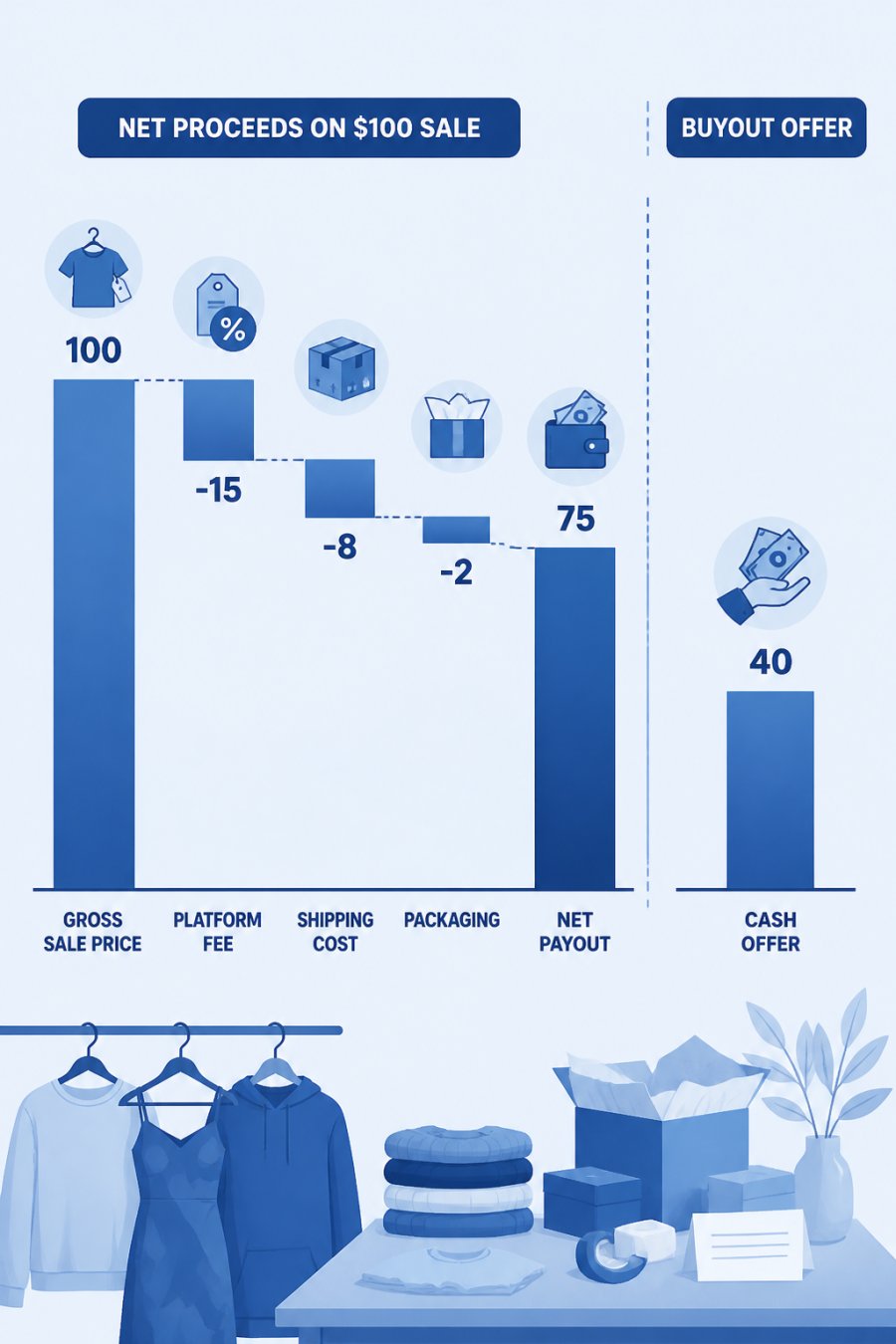
Most resale marketplaces charge a final value fee that ranges from roughly 8% to 20% of the sale price, and some add a fixed per-order fee. Payment processors may take another 2.9% plus a small fixed amount (Credit card terminal rates explained). Shipping is either paid by the buyer or deducted from your payout, and packaging runs about $1-$3 per order for a poly mailer or box. Time is a cost too: photographing, listing, answering questions, and shipping can take 30-60 minutes per item.
A simple net-proceeds formula:
Net payout = Sale price − platform fee − payment processing − shipping cost − packaging − (your time × hourly rate)
Example: A $100 sale on a marketplace with a 15% final value fee ($15), 2.9% + $0.30 payment processing ($3.20), $8 shipping, and $2 packaging nets about $71.80 before accounting for time. If the same item sells through a buyout service for $40 cash, the marketplace route nets more but requires more effort and carries the risk of not selling.
Set Your Asking Price with a Walk-Away Number
Start with recent sold comps for the same brand, size, and condition. Set your asking price slightly above your walk-away number so you have room to accept offers. For limited-edition or designer pieces, price higher and hold, scarcity supports premium pricing. For everyday brands, price competitively and plan to accept offers quickly to avoid stale inventory.
Pricing moves that work:
- Check sold comps for the exact brand, size, and condition
- Set your asking price 10-20% above your walk-away number
- Leave room for offers and negotiation
- Price limited-edition pieces higher, not lower
- Factor in platform fees, shipping, and packaging before you set a number
- Re-evaluate stale listings after 30 days and adjust or relist
How to Write Clothing Listings That Sell
A listing that sells answers every buyer question before they ask it. Lead with brand, size, fabric, and condition, then add measurements.
Include these details every time:
- Brand, size, and exact measurements
- Fabric content and care instructions
- Condition notes, including any flaws
- Fit and styling suggestions
Packaging, Shipping, and Managing Repeat Inventory
Careful packaging protects your payout and your reviews. Fold garments neatly, wrap in tissue, and ship in a weatherproof mailer.
For repeat sellers, keep a simple inventory system:
- Photograph and list within 48 hours of sourcing
- Track sell-through rate per category
- Store items flat and labeled by season
- Re-list stale items with fresh photos
Higher-value pieces deserve extra care. Our jackets category shows how to think about packaging and categorizing premium items for resale.
List Your First Piece and Start Your Resale Closet
The fastest way to learn how to resell your high quality clothing is to list one piece today. Start with a single strong garment, photograph it well, and price it from real comps.
Alana Kay Art designs limited-edition apparel built from original artwork. Our bold, artist-driven collections are made to be collected and worn.
Ready to build a closet worth reselling? Get started with Alana Kay Art and shop limited-edition pieces designed to stand out.
Frequently Asked Questions
What clothes sell best online?
Designer and limited-edition pieces, natural-fiber garments like linen and silk, statement outerwear, and anything with a recognizable brand name move fastest. Basics from fast-fashion labels rarely recover their cost. Condition matters as much as label: a pristine linen blouse outsells a stained designer dress. Check sold listings for your exact item before you list, and skip anything with heavy wear, missing buttons, or odors that cleaning cannot fix.
How do you price high-quality clothes for resale?
Start with sold comparable listings, not active ones, for the same brand, size, and condition. Price high-quality clothing at roughly 25 to 40 percent of original retail, then subtract platform fees and shipping from your asking price to see your real payout. Leave 10 to 15 percent of negotiating room. If a piece has not sold in 30 days, cut the price by 15 percent rather than relisting at the same number.
How should you photograph clothes for an online listing?
Use natural daylight near a window, never direct sun or flash. Steam the garment first, hang it on a plain neutral background, and shoot the front, back, label, care tag, and any flaw close-up. Include one flat-lay with a tape measure across the chest so buyers can judge fit. Clear photos taken in natural lighting reduce returns and disputes more than any other single step in the listing process.
Is reselling clothes a good way to make money?
It works best as a way to recover value from pieces you already own or to build a small side income from careful sourcing. Profit depends on buy-in cost, sell-through rate, and fees. Selling a $356 linen blouse you no longer wear for $120 nets far more than a consignment buyout offer. Treat it as a margin business: track what you paid, what you sold for, and your net after fees, shipping, and packaging.
Building a resale habit takes patience, but each listing teaches you what buyers value. When you're ready to add pieces worth keeping, Alana Kay Art offers limited-edition apparel made from original artwork. Shop our bold, artist-driven collections and find garments designed to be collected, worn, and passed on.

Leave a comment