How to Identify Greenwashing in Fashion Brands
Last Updated: November 9, 2026
Quick Summary
To identify greenwashing in fashion, read the label in layers: check the mandatory fiber percentages, then verify every voluntary certification number on the certifier's own database rather than the brand's site. Pause on vague claims like carbon neutral or 100% sustainable that come with no proof, and confirm the certification's scope actually covers the claim being made.
- Vague terms like eco-friendly and sustainable have no fixed legal meaning in most clothing marketing.
- In the US, the FTC Textile and Wool Acts require fiber content, country of origin, and maker identity on most clothing labels.
- Verify a certification number on the certifier's site, not the brand's, in under two minutes.
- GOTS covers fiber and processing but does not confirm living wages at the sewing floor.
- A six-step audit includes checking the fiber label, searching certifier databases, and reviewing repair policies.
Table of Contents
- Why Greenwashing in Fashion Is Getting Harder to Spot
- Greenwashing in Fashion Examples You Will Recognize
- How to Read Greenwashing Clothing Labels
- Fashion Sustainability Claims That Should Make You Pause
- Sustainable Fashion Certifications Worth Checking
- A Step-by-Step Audit for Verifying a Brand's Claims
- Your Consumer Rights and Legal Recourse
- Apply the Checklist Before Your Next Purchase
- Frequently Asked Questions
Why Greenwashing in Fashion Is Getting Harder to Spot
Greenwashing in fashion is the practice of making a brand look more eco-friendly than it really is, and it is getting harder to spot because the language has become polished and vague.
The problem is not that brands lie outright. Most use words that sound green but mean nothing. A single good deed, like one recycled tee, can hide a much bigger problem.
Below, we break down the exact claims to question and the steps to check them. You will also find a simple checklist you can use before you buy.
Greenwashing in Fashion Examples You Will Recognize
You have seen these greenwashing in fashion examples on labels and websites. They are common, and each one is easy to miss.
Vague Buzzwords and Misleading Imagery
Words like "eco-friendly," "all-natural," and "sustainable" have no fixed legal meaning in most clothing marketing. A brand can print them on a tag without proof. Watch for leafy green logos, earth-tone palettes, and photos of forests that have nothing to do with how the item was made. This is green marketing at its most basic: sell the feeling, skip the facts.
The Hidden Trade-Off and Recycled Material Overreach
The hidden trade-off is when one green feature hides a larger harm. A jacket made from recycled polyester still sheds plastic fibers and relies on energy-heavy production. That single callout does not make the whole garment low-impact. Recycled content is good, but it is not the full story. When a brand leads with one material and stays quiet about labor practices or toxic dyes, ask why.
How to Read Greenwashing Clothing Labels
Reading greenwashing clothing labels starts with knowing which parts of a label are legally required and which are marketing. In the United States, the FTC Textile and Wool Acts require most clothing sold to consumers to carry a label stating fiber content by generic name and percentage, country of origin, and the identity of the manufacturer or marketer.
Here is how to read a label in layers, from the mandatory base to the optional claims.
Layer 1: The Mandatory Fiber Disclosure
The fiber list is the one place a brand cannot legally stay vague. Look for exact percentages ("60% cotton, 40% recycled polyester") rather than "mostly cotton" or "cotton blend." A generic fiber name must be used, so "organic cotton" should appear alongside a certification reference if the organic claim is real.
Watch out: A fiber percentage tells you what the item is made of, not how it was made, recycled polyester and virgin polyester can carry the same fiber name, so the percentage alone does not prove a lower-impact garment.
Layer 2: Country of Origin and Maker Identity
The "Made in" line tells you where the garment was assembled, not where the fiber was grown or the fabric woven. A shirt sewn in one country may use fabric from another and yarn from a third. The manufacturer or marketer identity is required, which gives you a real company to search. Use that name to look up the brand's supply chain disclosures, factory lists, and any public commitments.
Layer 3: Certification Logos and Registration Numbers
A real certification logo is traceable. GOTS, OEKO-TEX, Fair Trade, B Corp, and bluesign all maintain searchable databases or license numbers. A logo with no registration number, no license code, and no database entry is decoration. Copy the number and search the certifier's own site, not the brand's site, to confirm the product or facility is actually covered. Certifications also have scope limits: a GOTS logo covers fiber and processing, not labor wages; a bluesign approval covers mill chemistry, not the finished garment's full life cycle.
Layer 4: Care, Repair, and Longevity Signals
A care label that gives real washing and repair detail usually signals a garment designed to last. A label that says only "dry clean" or offers no fiber-specific care guidance is a weaker longevity signal. Pair the care label with the brand's published repair and return policy. A long-life claim without a repair path is a marketing claim, not a design commitment.
Layer 5: The Claims That Are Not on the Label
The most common greenwashing move is what the label leaves out. If a brand leads with one recycled material but stays silent on dye chemistry, factory labor, or end-of-life, the label is doing selective work.
A label is a starting document, not a verdict. Read the mandatory layers first, then treat every voluntary claim as something to verify against a certifier database, a supply chain disclosure, or a Digital Product Passport.
Fashion Sustainability Claims That Should Make You Pause
Certain fashion sustainability claims should make you pause every time, because they are hard to prove and easy to abuse. A common mistake is trusting a claim just because it sounds technical. Here is what to question:
- "Carbon neutral" with no offset details
- "Ethically made" with no factory named
- "100% sustainable" (no garment is)
None of these are illegal on their own, but none prove anything. The FTC's Green Guides ask marketers to back environmental claims with real evidence. When a brand cannot, that is your answer.
Sustainable Fashion Certifications Worth Checking
Sustainable fashion certifications are the fastest way to verify a claim, but only if you understand what each one actually covers and how to confirm the logo is real. A certification is not a general stamp of approval, each one verifies a specific part of the supply chain, and a brand can hold one while leaving the rest unaddressed. Use the table below as a map of scope, then verify the registration number on the certifier's own site.
| Certification | What It Actually Verifies | Scope Limit to Know | How to Verify |
|---|---|---|---|
| GOTS (Global Organic Textile Standard) | Organic fiber content and processing chemicals from field to finished textile | Covers fiber and processing, not wages or garment end-of-life | Search the GOTS public database by license number |
| OEKO-TEX Standard 100 | Harmful substances in the finished article | Tests the final item, not the mill's full chemical management | Look up the certificate number on the OEKO-TEX label check |
| Fair Trade (Fairtrade International) | Labor practices and minimum prices for certified commodities | Applies to specific certified ingredients, not the whole garment | Confirm the license code on the certifier's database |
| B Corp | Whole-company social and environmental performance score | Brand-level score, not product-level proof | Check the brand's public B Corp profile and score |
| bluesign | Chemical and resource use at the mill level | Covers mill inputs, not the finished garment's full life cycle | Search the bluesign system partner list |
What a Certification Does Not Prove
A common mistake is treating one logo as proof the whole garment is low-impact. GOTS can confirm organic cotton and approved processing, but it does not confirm living wages at the sewing floor.
Watch out: Certification logos are sometimes used on a brand's website without a product-level license number. A logo on a marketing page is not the same as a license number on the product label, verify the number, not the image.
How to Verify a Certification in Under Two Minutes
- Copy the registration or license number from the product label or the brand's product page.
- Go to the certifier's own website, not the brand's site, and use its public database or label check.
- Confirm the product, facility, or company name matches what you are buying.
- Check the certification's scope against the claim the brand is making. If the brand claims "ethically made" but the only certification is OEKO-TEX, the labor claim is unverified.
The Certification Gap Competitors Skip
Most guides list certifications without explaining scope limits, which is exactly where greenwashing survives. A brand can hold a real GOTS certificate for one product line and use the logo to imply the whole company is sustainable.
For a deeper layer, look for certifications that publish facility-level or product-level data you can search, and treat brand-level scores (like B Corp) as context rather than product proof.
A Step-by-Step Audit for Verifying a Brand's Claims
Verifying a brand's claims takes about ten minutes if you follow the same steps every time. Here is our six-step audit for how to identify greenwashing in fashion brands:
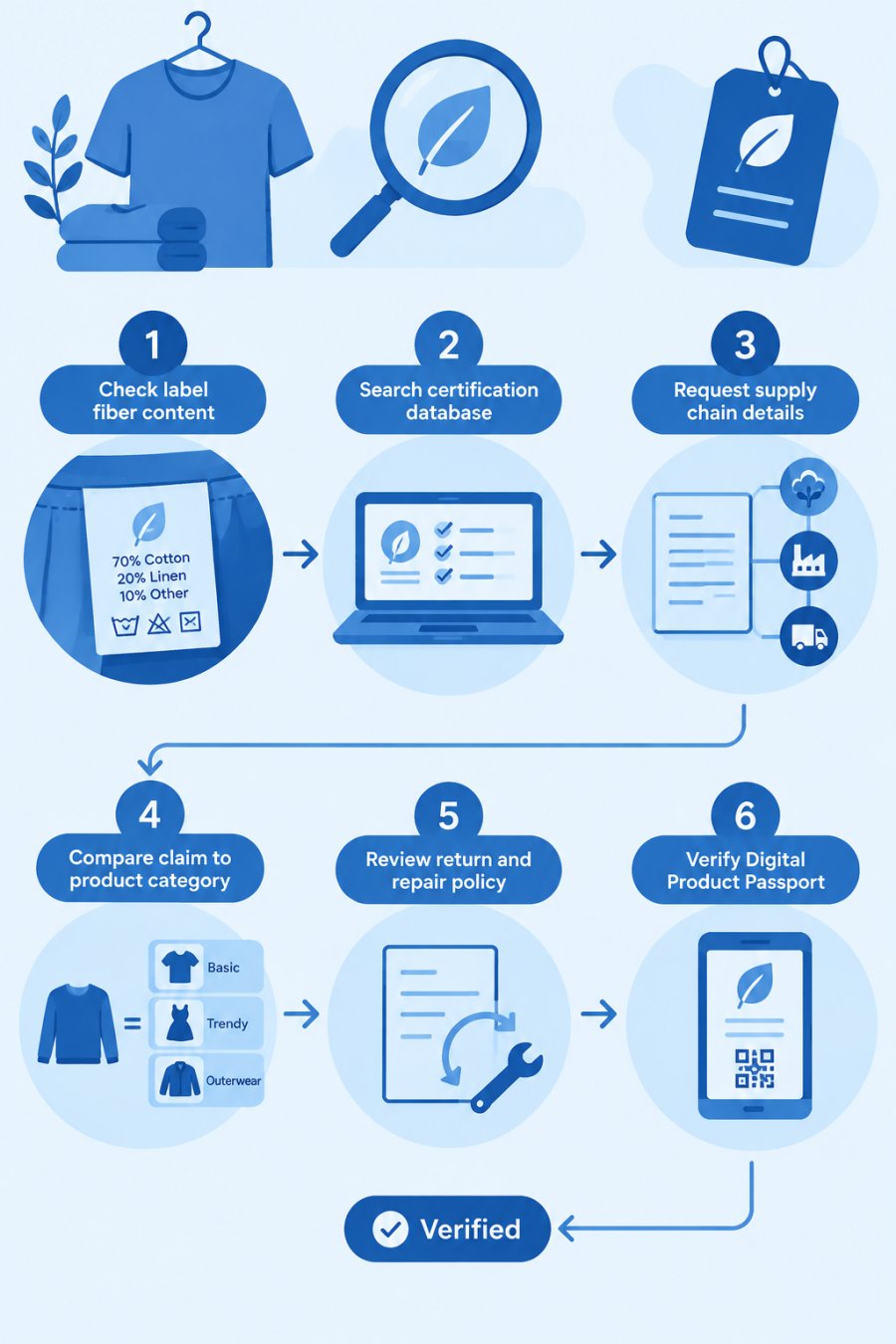
- Check the fiber label. Note exact percentages and any certification numbers.
- Search the certifier's database. Type the number in and confirm it matches the product.
- Ask for supply chain details. A real brand can name its mills or makers.
- Compare the claim to the category. A "green" polyester dress still has a carbon footprint.
- Review the repair and return policy. Long-life design usually comes with real support.
- Look for a Digital Product Passport. More brands now link a scannable record of materials and origin.
Digital Product Passports and the Green Premium
A Digital Product Passport (DPP) is a scannable record that shows a garment's materials, origin, and care. It is the clearest traceability tool on the horizon, and it makes verification far easier. The green premium is the extra you pay for a lower-impact item. A DPP helps you judge whether that premium buys real value or just a nicer label.
Your Consumer Rights and Legal Recourse
You have real consumer rights when a green claim turns out to be false. Deceptive environmental marketing can count as a deceptive practice under FTC advertising rules, and state consumer protection laws add more. If you bought an item based on a claim you can prove was false, you may have grounds for a refund or a complaint. Keep the tag, the listing, and your receipt.
Apply the Checklist Before Your Next Purchase
Run this checklist before you buy, and greenwashing gets much harder to fall for:
- Fiber content is stated with exact percentages
- At least one certification has a searchable number
- The brand names its makers or mills
Alana Kay Art's limited-edition apparel is built from original artwork and commissioned illustrations, and is designed to be collected and worn. If you want clothing with a clear point of view, explore the Alana Kay Art collection.
The real test of any brand is whether it can show its work. We design bold, artist-driven pieces for people who want individuality over mass production, and we are happy to answer questions about what you are buying.
Frequently Asked Questions
What is an example of greenwashing in fashion?
A common example is a brand releasing a small capsule collection made from recycled polyester while the rest of its line relies on virgin synthetic fibers and fast-fashion production volumes. The capsule gets the eco-friendly marketing, but the environmental impact of the business barely changes. Another example is a label that says all-natural without listing fiber percentages or dye content, since natural fibers can still be processed with toxic dyes and heavy water use.
Are vague terms like eco-friendly or conscious reliable?
Treat them as marketing language, not evidence. Terms like eco-friendly, conscious, and green have no single legal definition in US apparel labeling, so any brand can print them. A reliable fashion sustainability claim names a specific fiber, a percentage, a certification body, or a measurable outcome. If a product page uses only adjectives and no numbers, that is your signal to ask the brand directly or move on.
How can you verify a fashion brand's sustainability claims?
Start with the label: note fiber percentages and any certification logos, then check that the certifying body actually exists and covers the claim being made. Request supply chain transparency details, such as the name of the mill or factory, and see whether the brand answers with specifics or a generic statement. Compare the claim to the product category, since a recycled content claim says nothing about labor practices. Finally, check whether the brand publishes a lifecycle assessment or third-party audit.
What should you look for on clothing labels and product pages?
Look for fiber content by percentage, country of manufacture, care instructions, and named third-party certifications rather than house-designed green logos. On product pages, look for material sourcing details, factory names or regions, and any verification documents. If a page promotes a recycled polyester blend but never states the percentage of recycled content, or shows certification badges with no registry number, treat the claim as unsubstantiated until the brand provides proof.

Leave a comment