
How to Hang Large Art Pieces in Small Apartments
Last Updated: November 12, 2026
Quick Summary
To hang large art in a small apartment, treat the piece as the room's anchor and hang its center 57 inches from the floor. Size it so its width is about two-thirds the width of the furniture below it, and use studs or rated anchors for heavy pieces.
- Hang art so its center sits 57 inches from the floor, the standard gallery height.
- Leave 6 to 10 inches between the frame bottom and the couch back.
- Use two hangers or a French cleat for anything wider than about 30 inches.
- Adhesive strips work best on smooth painted drywall and fail on textured plaster or brick.
- Space gallery wall pieces 2 to 3 inches apart and align outer edges to a clean rectangle.
Table of Contents
- Why Large-Scale Art in Small Spaces Works
- How High to Hang Wall Art: The 57-Inch Rule and 2/3 Rule
- How to Hang Heavy Artwork Safely in an Apartment
- How to Hang Paintings on a Wall Without Nails
- Arranging Multiple Pieces as One Cohesive Grouping
- Leaning, Mirrors, and Vertical Space: Layouts for Tight Rooms
- Choosing Your Statement Piece from Alana Kay Art
- Frequently Asked Questions
Why Large-Scale Art in Small Spaces Works
The best way to hang large art in a small apartment is to treat the piece as the room's anchor, not its decoration.
The math is simple. Small frames create many edges, and many edges read as visual noise.
Apartment Therapy's small-space decorating guides make the same case: fewer, bigger pieces read as calmer and more expensive than a crowded wall.
The focal point effect: one big piece instead of five small ones
A focal point is the spot your eye goes to first when you enter a room. In a small apartment, you want exactly one per room. Pick the wall you see from the doorway or the one behind your couch, and give it your largest piece.
- One large work: one focal point, calm room
- Five small frames: five focal points, busy room
- Two medium works side by side: a grouping, still one focal point
Keep the rest of the wall quiet. A lamp, a plant, or nothing at all.
How High to Hang Wall Art: The 57-Inch Rule and 2/3 Rule
Hang wall art so its center sits 57 inches from the floor. That is average eye level, and it is the standard most galleries and designers use.
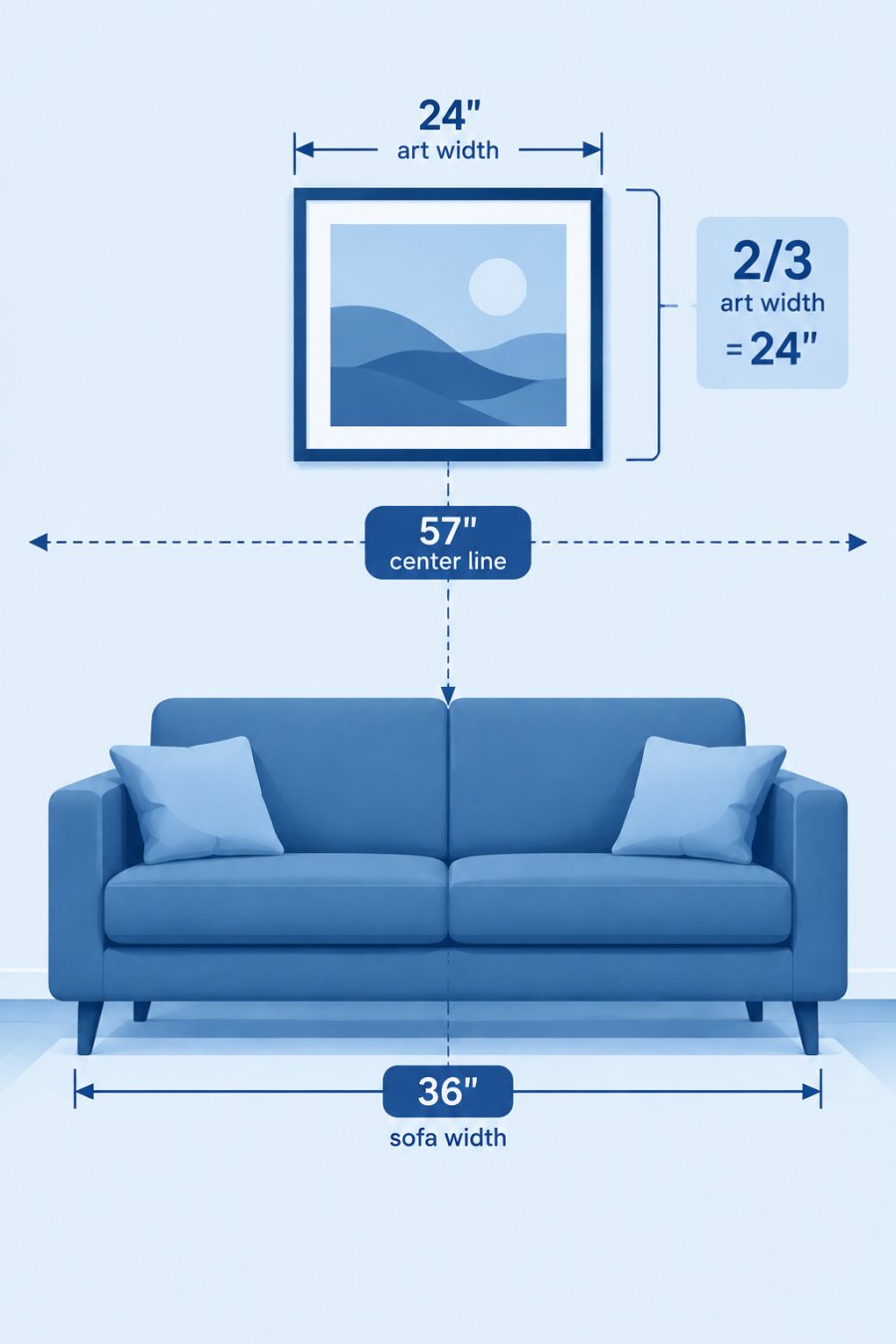
Those two numbers solve most hanging decisions before you pick up a hammer. The 57-inch rule as used by gallery and museum installers comes from the museum world, where consistent center height keeps a whole gallery readable at a glance.
Measuring above furniture and around wall dimensions
Measure from the floor up, not from the top of the couch. Furniture moves; the 57-inch line does not.
- Above a couch: leave 6 to 10 inches between the frame bottom and the couch back
- Above a bed: center the art over the headboard, bottom edge 8 to 10 inches above it
- On an empty wall: center at 57 inches and let the wall breathe around it
Watch out: hanging art too high is the most common mistake in small apartments. It stretches the room upward and leaves the furniture looking stranded.
Two numbers settle most hanging decisions before you pick up a hammer.
| Item | Value | Note |
|---|---|---|
| Center height from floor | 57 inches | Average eye level; standard gallery height |
| Art width vs. furniture width | About two-thirds | 36-inch sofa wants art roughly 24 inches wide |
| 60-inch sofa | About 40 inches wide | Art width at the 2/3 rule |
| Gap above a couch | 6 to 10 inches | Between frame bottom and couch back |
| Gap above a bed | 8 to 10 inches | Bottom edge above the headboard |
| Bare wall in a narrow room | At least 12 inches each side | If you can |
How to Hang Heavy Artwork Safely in an Apartment
Hang heavy artwork by transferring the load into wall studs or into anchors rated for several times the piece's weight, never into a single nail or a bare drywall screw. A framed original on wood panel can weigh far more than a poster, and apartment drywall will not hold that weight on its own.
Step 1: Identify your wall type
Press a thumb into the wall and look at the surface. Drywall gives slightly and sounds hollow when tapped; plaster feels hard and cold and may crack at the edges; brick and concrete are rigid and textured; and a stud finder will show you where the wood framing sits behind drywall. Knowing the wall type tells you which fasteners are even possible.
- Drywall over wood studs: the most common apartment wall; studs carry the most weight
- Plaster on lath: older buildings; anchors can crumble the plaster, so use a stud whenever one is available
- Brick or concrete: requires a masonry bit and a sleeve anchor or a tapcon-style screw
Step 2: Weigh the piece and read the hardware rating
Weigh the framed piece on a bathroom scale. Then read the fastener package and choose one rated well above that weight, a common pattern is to pick hardware rated for at least twice the piece's weight so there is margin for a bump or a slam. Hardware ratings are printed on the package and are the only number that matters; a fastener's size tells you little about its capacity.
- Under 20 pounds: a pair of rated hollow-wall anchors in drywall is usually enough
- 20 to 50 pounds: drive into studs where possible, or use heavy-duty toggle bolts
- Over 50 pounds: use two stud-mounted fasteners or a French cleat spanning at least two studs
Step 3: Choose the right hardware
- Two hooks or D-rings: spread the load and keep a wide frame from twisting out of level
- French cleat: a beveled pair of rails, one on the wall and one on the frame, that spreads load across the full width and lets the piece sit flush
- Toggle bolts: for hollow drywall where no stud is available; they open behind the wall and bear on a wide area
For anything wider than about 30 inches, use two hangers or a French cleat so the load spreads across the wall. A single hook lets a heavy frame twist and drift out of level.
Step 4: Plan the install around tight floor space
In a small apartment, the hard part is often the lift, not the drill. Measure the doorway and stairwell before the piece comes in, and carry a large frame vertically rather than flat.
- Mark both fastener points in pencil and check them with a level before drilling
- Drill, set the anchors, and test each one with a firm pull before the piece goes up
- Have a second person spot the piece while you level it
Watch out: a heavy frame hung on a single center hook will slowly rotate out of level and can pull the hook loose; always use two points of contact for wide or heavy pieces.
How to Hang Paintings on a Wall Without Nails
Hang paintings without nails by matching the method to two things: the weight of the framed piece and the surface of your wall. Most renter-friendly failures happen because someone picked the method first and checked the wall second. Work in the other order.
Start by weighing the piece on a bathroom scale, frame and glass included. Then identify your wall surface by pressing a thumb into it: drywall gives slightly, plaster feels hard and cold, brick and concrete are rigid and textured, and wallpaper sits on top of any of them.
Removable adhesive strips
Adhesive strips are the default renter answer, but they are surface-specific. They hold best on smooth, painted drywall and clean, flat frame backs. They let go early on textured plaster, brick, concrete, wallpaper, and freshly painted walls.
- Under 5 pounds: two strips on the back of a small frame are usually enough
- 5 to 15 pounds: use four to six strips, spread across the top and bottom of the frame, and press each for the full time the package states
- Over 15 pounds: skip adhesive entirely and move to a rail or a leaning arrangement
Watch out: adhesive strips fail in humid rooms such as bathrooms and above kitchen stoves, and they can pull paint when removed if the wall was painted within the last couple of weeks.
Removable hooks and rails
Removable hooks that use adhesive backing handle slightly more weight than flat strips because the load hangs from a hook rather than pulling straight down on the adhesive. Picture rails and adhesive-backed ledge rails spread weight across a horizontal bar and are the best no-nail option for a piece in the 10-to-20-pound range, because the rail distributes load across several inches of wall instead of a few square inches of strip.
- Adhesive hooks: good for lightweight frames with a wire or D-ring, not for heavy or wide pieces
- Adhesive rails and ledges: best for medium frames and for leaning a frame on a narrow ledge
- Removal risk: rails and hooks leave a larger adhesive footprint than strips, so removal takes more patience and a hair dryer to soften the adhesive
Leaning as a no-nail method
Leaning is the only truly zero-damage method, and it suits large pieces better than small ones. Lean a framed work on a console, a low shelf, or the floor, angled slightly back against the wall. Put a rubber bumper or felt pad on the bottom back corners so the frame does not slide or scuff the baseboard.
- Best for: oversized frames, works on paper behind glass, and pieces you plan to move
- Watch out: a leaning frame on a high shelf is a tipping hazard in a small apartment with kids or pets; secure the top with a removable strap or museum putty
Matching method to surface
- Smooth painted drywall: adhesive strips, hooks, or rails all work; strips are the least visible
- Textured plaster: adhesive fails; lean the piece or use a rail rated for the weight
- Brick or concrete: adhesive fails; lean the piece or move to a drill-and-anchor method
The tenant guidance on picture hanging and security deposits is worth a quick read before you commit, since patching rules vary by lease.
Arranging Multiple Pieces as One Cohesive Grouping
Treat a gallery wall as one large shape, not a collection of separate frames. Lay the pieces on the floor first and space them 2 to 3 inches apart.
A simple rule for mixing sizes: pick one anchor piece, then build outward with smaller works.
- Tight grid: same-size frames, even gaps, calm and formal
- Salon style: mixed sizes around one anchor, lively and collected
- Column: three stacked works in a narrow slot, ideal for tight walls
If you are torn between one big piece and a grouping, go with the single piece in a small room.
Leaning, Mirrors, and Vertical Space: Layouts for Tight Rooms
Lean framed art on the floor or a console when you want a casual feel and zero wall damage.
Mirrors do a different job. Place one opposite a window to bounce natural light deeper into the room.
Then look up.
- Lean oversized pieces on a console or the floor, angled slightly back
- Hang a mirror across from your main light source
- Use the wall above doorways for one narrow piece
Before you move a big frame, measure the doorway and stairwell. Carry it vertically, not flat, and clear the path first.
Choosing Your Statement Piece from Alana Kay Art
Pick a piece you will still love after the couch changes.
Here is how we would choose for a small apartment:
- Biggest wall, biggest piece: Heaven Falls, Earth Rises measures 49 by 39 inches with its custom frame.
- Square walls and tight corners: Valkyra at 36 by 36 inches fits neatly over a chair or console.
- Color as the focal point: Psychedellic Sunrise brings luminous resin and bold hue to a neutral room.
- Playful, conversation-starting energy: Jelly Bellies adds instant personality to a small living room.
Each is an original painting by Alana Kay, framed and ready to hang. Measure your wall, check the 57-inch line, and pick the piece that fits your space.



Small apartments punish clutter and reward confidence. One bold original, hung at the right height and secured properly, will do more for a tight room than a dozen small frames.
Frequently Asked Questions
What is the 57-inch rule for hanging art?
The 57-inch rule places the center of your artwork 57 inches from the floor, which matches the average eye level in most homes. Measure from the floor to the middle of the frame, not the top. For large art above a sofa, keep the bottom edge 6 to 10 inches above the furniture back. If your ceilings are unusually high or low, shift the center line a few inches so the piece feels balanced in the room.
How can I hang large art in an apartment without damaging the walls?
Use adhesive hanging strips rated well above your artwork's weight, and clean the wall with rubbing alcohol before applying them. For pieces over roughly 20 pounds, switch to a single small nail into a stud or a removable toggle anchor, which leaves a hole no bigger than a pencil tip. Command-style strips and toggle anchors are both standard renter options. Always check your lease first, since some buildings require nail-free mounting.
How do I know what size art fits a small wall?
Measure the wall's width and height, then aim for art that fills about two-thirds of the width of the furniture below it. On a narrow wall, a single piece 24 to 36 inches wide usually reads as intentional rather than cramped. Leave at least 6 inches of breathing room on each side and 8 to 10 inches between the art and the ceiling. Masking tape on the wall at the planned dimensions is a quick way to test the fit before you commit.
Can I lean a large framed piece instead of hanging it?
Yes, leaning works well in rentals because it needs no hardware at all. Set the frame on a console, ledge, or the floor and lean it back against the wall at a slight angle. Secure the top with museum putty or a furniture strap so it cannot slide, and keep it away from doorways and radiators. Leaning suits bold abstract pieces and gives a casual, gallery-style feel, but avoid it on unsecured shelves or in homes with young children.

Leave a comment