
How to Calculate Cost Per Wear for Clothes: A True Cost Method
Last Updated: November 4, 2026
Quick Summary
To calculate cost per wear, divide the garment's purchase price by the number of times you wear it. For a truer figure, use (purchase price + care costs - resale value) ÷ number of wears, which captures what a garment really costs over its life.
- A $216 satin blouse worn 40 times with $40 care and $60 resale costs $4.90 per wear.
- Add tax, shipping and return fees to the purchase price so your cost per wear isn't artificially low.
- For seasonal items, multiply weekly wear estimates by the weeks in season, not 52.
- Targets range from under $1 for everyday basics to under $15 for occasion wear.
- Wash less often, store properly, repair small damage and track wears to keep the math in your favor.
Table of Contents
- The Cost Per Wear Formula and Why It Beats the Price Tag
- How to Calculate Cost Per Wear Step by Step
- Using a Cost Per Wear Calculator
- What Is a Good Cost Per Wear?
- Adding a Clothing Resale Calculator to Your Math
- The Average Cost of Clothing Per Month for 1 Person
- Building a Wardrobe That Rewards Every Wear
- Frequently Asked Questions
The Cost Per Wear Formula and Why It Beats the Price Tag
Most shoppers judge a garment by the number on its tag. That number tells you what you pay once. It says nothing about what the piece costs you every time you actually put it on. Cost per wear is the practice of dividing what a garment truly costs by how many times you wear it, and it is the single most useful number in a slow-fashion wardrobe.
At Alana Kay Art, we think about cost per wear constantly. Our pieces are made to be collected and worn for years, not for one season. Below, we'll show you exactly how to calculate cost per wear for clothes, including the care and resale costs most guides skip.
Here is the core idea: a $30 top worn twice costs $15 per wear. A $216 satin blouse worn 40 times costs about $5.40 per wear.
The Basic Formula
The cost per wear formula is simple: purchase price divided by the number of times you wear the garment. That is the starting point.
The true cost per wear formula goes further:
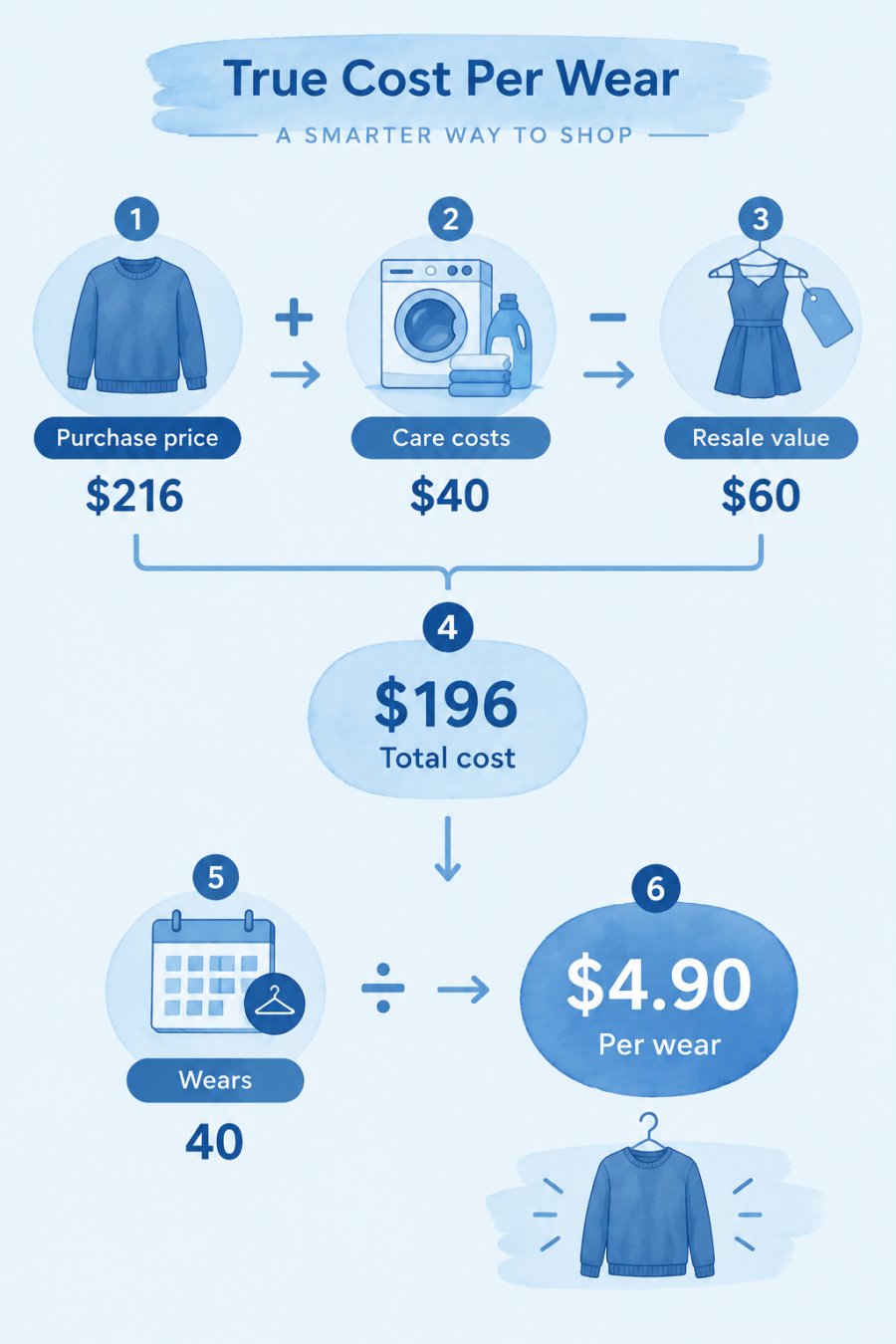
(Purchase price + care costs - resale value) ÷ number of wears
This version captures what a garment really costs you over its life. It rewards quality, because durable pieces survive more wears and hold resale value.
A Worked Example
Take a $216 satin button-up blouse. Say you wear it 40 times over three years. Dry cleaning and gentle care add about $40. You could resell it for roughly $60.
- Total true cost: $216 + $40 - $60 = $196
- Cost per wear: $196 ÷ 40 = $4.90
Now compare a $30 fast-fashion top worn five times and then discarded. Its cost per wear is $6.00, and it gave you five wears, not forty. The blouse wins on both math and longevity.
How to Calculate Cost Per Wear Step by Step
Follow these three steps and you'll have a reliable number for any garment in your closet. It takes about two minutes per item once you get the rhythm.
Step 1: Find the True Purchase Price
Start with what you actually paid, not the sticker price. Add tax and shipping. If you bought it on sale, use the sale price.
This is where the math gets honest. A bargain that never leaves the hanger is not a bargain. If you want to see how the formula plays out on a real investment piece, you can browse the Penny Deluxe Wild Horses Faux Fur Trim Coat and run the numbers yourself.

Watch out: shipping and return fees can raise the true purchase price, so include them or your cost per wear will be artificially low.
Step 2: Estimate Wear Frequency and Lifespan
Count how often you realistically wear the item per year, then multiply by the years you expect it to last.
Be honest here. People often overestimate wear frequency. A common mistake is assuming you'll wear a statement piece weekly when monthly is closer to reality. Track your wears for a month if you're unsure.
For seasonal items, adjust for climate. A heavy wool coat in a cold climate might get 90 wears per year, while the same coat in a mild climate might get 20. Use a realistic seasonal window: if you only wear a piece three months out of the year, multiply your weekly wear estimate by 12 weeks, not 52. This seasonal adjustment is a step most guides skip, but it prevents wildly optimistic cost per wear figures for climate-specific garments.
Step 3: Add Maintenance and Resale Value
Add the real cost of keeping the garment alive: dry cleaning, repairs, and special detergents. Then subtract what you could resell it for.
This step is where most cost per wear guides stop short. Care costs matter. A dry-clean-only coat carries a different total cost of ownership than a machine-washable blouse. To estimate care costs, check your local dry cleaner's price per item and multiply by the number of cleanings per year. For a coat cleaned twice a season at $25 each, that's $50 per year.
Resale value is the other half of this step. Check what similar pieces from the same brand sell for on secondhand platforms, then subtract selling fees and shipping.
Watch out: forgetting to subtract resale value can make a durable piece look more expensive than it is, while ignoring care costs can make a cheap piece look like a bargain when it isn't.
Using a Cost Per Wear Calculator
A cost per wear calculator is a simple tool that divides your total garment cost by your estimated wear count.
Set up four columns: item, total cost, estimated wears, and cost per wear. Enter the formula in the last column. Every new purchase gets a row.
Why bother? Because seeing the number changes how you shop. A clothing budget becomes a cost-benefit analysis instead of a guessing game. The calculator turns vague "is this worth it?" feelings into a clear figure you can compare across items.
What Is a Good Cost Per Wear?
A good cost per wear depends on the garment and how often you wear it. The lower the number, the better value the garment delivers over its life.
But context matters. A cocktail dress worn three times a year has a different target than a work blouse worn weekly. Judge each item against its category, not against a single universal number.
Here is a simple benchmark table to guide your decisions:
| Garment Type | Target Cost Per Wear | Typical Wear Frequency |
|---|---|---|
| Everyday basics | Under $1 | 50+ wears per year |
| Workwear | Under $3 | 30-40 wears per year |
| Statement pieces | Under $5 | 10-20 wears per year |
| Occasion wear | Under $15 | 3-5 wears per year |
| Outerwear | Under $2 | 60+ wears per year |
If a piece lands well above its target, that is your signal to pause. Ask whether you'll really wear it enough to bring the number down.
The psychological barrier is real. Many shoppers resist tracking because it forces them to confront impulse purchases, and the resulting guilt can lead to analysis paralysis, where you freeze and buy nothing, or buy everything to avoid the discomfort.
Watch out: comparing a statement piece to an everyday basic will make the statement piece look like a failure, when it may be delivering exactly the value you intended.
Adding a Clothing Resale Calculator to Your Math
A clothing resale calculator estimates what a garment will be worth when you're done with it, and subtracting that figure lowers your true cost. Resale value is the most overlooked part of the cost per wear equation.
Resale platforms have made this practical. According to thredUP's annual resale report, the secondhand market continues to grow as shoppers treat resale value as part of a garment's worth.
To estimate resale value, check what similar pieces from the same brand sell for used. Then subtract selling fees and shipping. A garment that resells for a meaningful amount effectively costs you less per wear.
This is where quality over quantity pays off twice.
The Average Cost of Clothing Per Month for 1 Person
The average cost of clothing per month for one person varies widely by lifestyle. Rather than chase a single national figure, track your own.
Here is a simple monthly clothing budget method:
- Add up what you spent on clothes last month
- Divide by the number of new items you bought
- Note the cost per wear of each item
- Flag anything above its category target
- Cut spending on high cost per wear categories next month
A capsule wardrobe approach helps here. Fewer, better pieces means a lower monthly spend over time and a wardrobe where every item earns its place. According to the EPA's guidance on reducing and reusing textiles, keeping clothing in use longer is one of the most effective ways to cut fashion waste, which aligns with the cost per wear mindset.
Watch out: the trap is buying more cheap items to "save money," then replacing them constantly. That pattern raises your true monthly cost, not lowers it.
Building a Wardrobe That Rewards Every Wear
Building a wardrobe that rewards every wear means choosing pieces with high wear frequency and long lifespans, then caring for them so they last. The goal is a closet where nearly everything sits under its cost per wear target.
Start with versatile staples that work across seasons. A linen-blend button-up, for example, layers year-round and earns its keep fast. You can shop the Button Up Blouse in Linen to see a piece built for exactly this kind of repeat wear.

Then add a few bold, limited-edition pieces that make getting dressed feel like an event. Those are the pieces many wearers reach for again and again. If you're still hunting for where to find them, our guide on where to buy unique colorful clothing walks through the best spots.
A few habits keep the math working in your favor:
- Wash less often and spot-clean when you can
- Store pieces properly to protect shape and fabric
- Repair small damage before it spreads
- Track wears so you know what's truly earning its place
- Resell or donate what you no longer wear
Many shoppers resist tracking because it forces them to confront impulse purchases. Seeing your wardrobe as a set of cost per wear figures can help you shop more deliberately.
Frequently Asked Questions
What is the formula for calculating cost per wear?
Divide the purchase price by the number of times you expect to wear the item. A $216 satin blouse worn 40 times costs about $5.40 per wear. For a truer number, add cleaning and repair costs to the price, subtract any resale value you expect, then divide by wear count. That adjusted figure is what separates an investment piece from an impulse purchase.
Should alterations and repair costs be included in cost per wear?
Yes. Hemming, tailoring, dry cleaning and repairs are part of what the garment actually costs you. Add them to the purchase price before dividing. A $598 coat that needs two $25 dry cleans a season carries a real cost above its price tag. Including maintenance stops cheap fast fashion from looking artificially good and rewards garments that hold up over years of wear.
Can a cost per wear calculator help compare clothing items?
It can, if you feed both items the same assumptions. Run a $216 chiffon blouse you will wear weekly against a $40 top you will wear three times to see how wear frequency and estimated lifespan change the result. Use a cost per wear calculator to test wear count and resale value side by side before you buy.
How many times do you need to wear an item to lower its cost per wear?
Every wear lowers it, but the drop is steepest early on. A $356 linen blouse worn 10 times sits at $35.60 per wear; at 50 wears it falls to $7.12. Track wear count for a month to see which pieces in your closet actually earn their place.
The challenge is simple: stop letting the price tag make your decisions. Start calculating true cost per wear, and let the math guide you toward pieces you'll wear for years. At Alana Kay Art, our limited-edition apparel is designed to be collected and worn, with bold color and thoughtful design that make every wear count. Explore our artist-driven collections, find a piece that earns its place in your wardrobe, and get started with Alana Kay Art today.

Leave a comment