
How to Build a Slow Fashion Wardrobe That Lasts
Last Updated: October 26, 2026
Quick Summary
Slow fashion benefits women by saving money through lower cost per wear, reducing textile waste, and building a wardrobe of higher-quality pieces that last. Buying fewer, better clothes and keeping them in use through care and repair pays off in your budget, your getting-dressed routine, and less clothing sent to landfill.
- Cost per wear is a garment's price divided by the number of times you wear it.
- Track your outfits for two weeks to audit what you actually wear.
- Repair hems, replace buttons, and mend seams before replacing a garment.
- Choose new pieces that work with at least three existing outfits.
- Verify ethical claims by checking named fibers, supplier lists, and third-party certifications.
Table of Contents
- Why Slow Fashion Benefits Women's Wardrobes and Budgets
- Slow Fashion vs Fast Fashion Quality: What You Actually Get
- 1. Less Textile Waste and a Lighter Environmental Footprint
- 2. Higher-Quality Clothing That Survives Real Life
- 3. Cost Per Wear: The Math That Changes How You Shop
- 4. Ethical Production and Supply-Chain Transparency
- 5. Timeless Style and a More Personal Look
- How to Build a Slow Fashion Wardrobe Without Starting Over
- The Bottom Line on Building a Wardrobe That Lasts
- Frequently Asked Questions
Why Slow Fashion Benefits Women's Wardrobes and Budgets
The benefits of slow fashion for women start with a simple shift in thinking: fewer, better pieces that earn their place in your closet. At Alana Kay Art, we offer limited-edition apparel based on original artwork. Slow fashion is the practice of buying fewer clothes, choosing higher-quality pieces, and keeping them in use through care and repair. The payoff shows up in your budget, your daily getting-dressed routine, and the amount of clothing that leaves your closet for a landfill.
Below, we break down five concrete benefits and show you exactly how to build a slow wardrobe without throwing out what you already own. But first, here's what most guides get wrong: they frame slow fashion as a sacrifice. It isn't. It's a trade of volume for value.
Slow Fashion vs Fast Fashion Quality: What You Actually Get
The difference between slow fashion and fast fashion quality comes down to construction, fabric, and how long the garment holds up.
What changes in practice:
- Design: prints and colors that don't expire when a trend does
That last point matters most for women building a wardrobe that works across work, weekends, and events.
1. Less Textile Waste and a Lighter Environmental Footprint
Every garment you keep in rotation is one that doesn't go to a landfill. Clothing production consumes water, energy, and raw materials.
The U.S. Environmental Protection Agency's data on textiles in municipal waste tracks how much clothing and fabric ends up in the waste stream each year. Buying less and wearing longer works directly against that number. It also cuts the pollution and greenhouse gas emissions tied to making and shipping new clothes.
2. Higher-Quality Clothing That Survives Real Life
We build our straight leg pants with pockets with an elastic waist, pockets, and satin fabric. A common mistake is judging quality by the label alone.
3. Cost Per Wear: The Math That Changes How You Shop
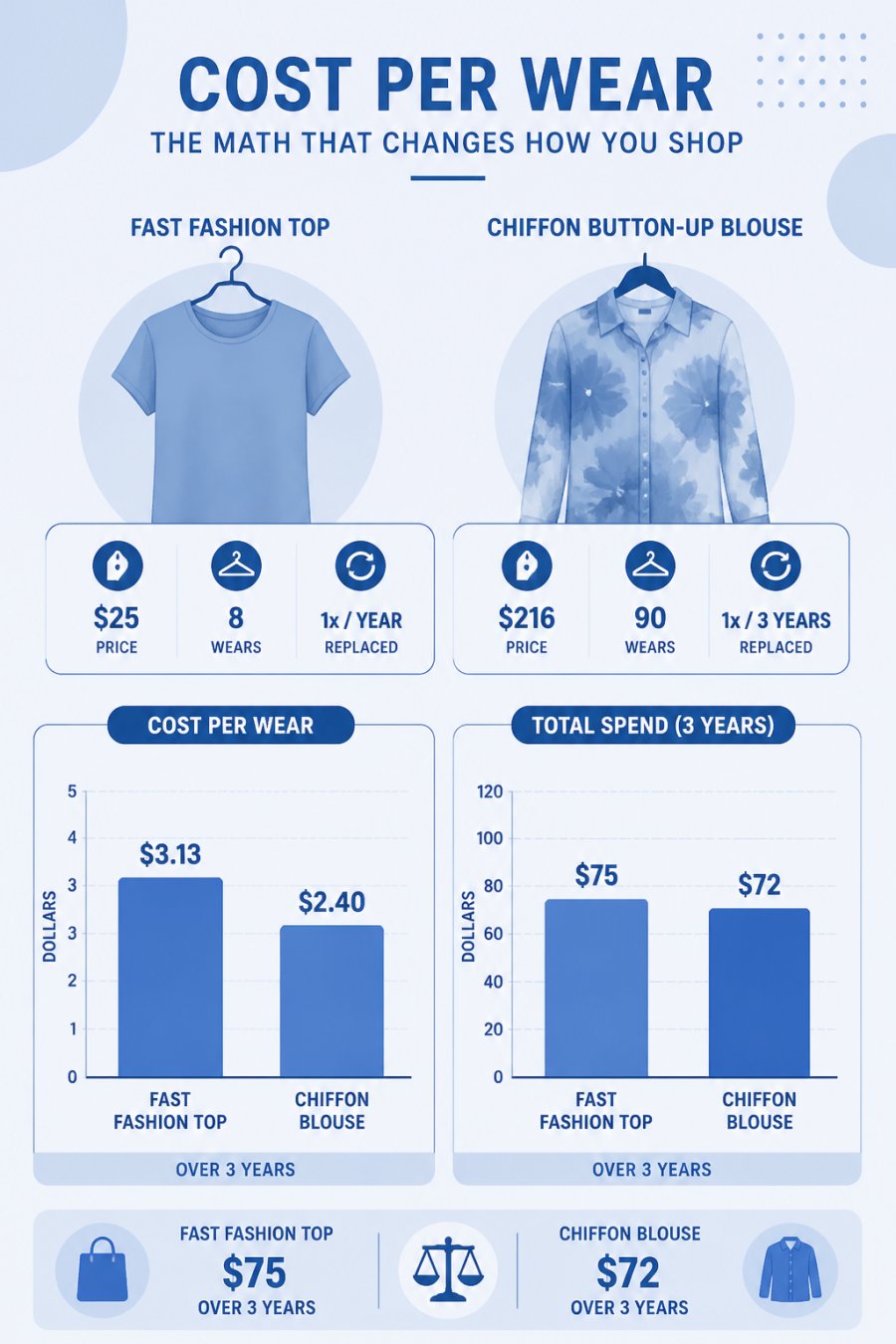
Cost per wear is the price of a garment divided by the number of times you wear it. A lower price means nothing if the piece gets worn twice and then sits in a drawer. This number can help women compare a higher upfront price with how often they expect to wear a garment.
How to run the math
- Estimate wears per year. Be honest. A work blouse or a statement dress may be worn different numbers of times in a year.
- Divide price by total wears over the life you expect. If you think a piece will last three years, multiply annual wears by three first.
- Add care and repair costs. Dry cleaning, alterations, and replacing buttons are part of the real cost.
- Compare against the replacement cycle. A top that needs replacing has to be bought again, so its total cost includes the replacements.
A worked comparison
The button up blouse in chiffon is $216. You can estimate cost per wear by dividing a garment's price by the number of times you wear it.
The practical answer is not to replace your closet at once. Buy one piece in a category you wear often, work tops, pants, or a coat, and consider its cost per wear before you spend more.
4. Ethical Production and Supply-Chain Transparency
Ethical fashion asks a basic question: who made this, and under what conditions? Supply-chain transparency means a brand can tell you where and how a piece was made, and, crucially, that you can check the claim rather than take it on faith.
Most guides stop at "look for ethical brands." The useful part is knowing how to verify. Here is a practical checklist you can run against any label or product page.
A verification checklist
- Materials: Is the fiber named specifically (for example, 100% linen or organic cotton) rather than described vaguely as "eco-friendly fabric"? Specific fiber content is a baseline disclosure.
- Labor standards: Does the brand name the factories or regions where garments are cut and sewn, or at least describe its supplier code of conduct and how it is audited?
- Certifications: Look for recognized third-party marks rather than self-designed badges. Common ones include GOTS for organic textiles, Fair Trade certification for labor, and OEKO-TEX for chemical safety testing. A certification is only useful if you can confirm it applies to the specific product.
- Supply-chain disclosure: Does the brand publish a supplier list, a transparency report, or a traceability statement? A brand that can name its mills and factories is generally further along than one that cannot.
- Environmental claims: The Federal Trade Commission's Green Guides explain how environmental marketing claims should be substantiated. Use that standard: a claim like "sustainable" or "eco-friendly" without specifics is marketing, not evidence.
Questions worth asking directly
A short email or chat message to a brand can help you ask where the fabric is sourced, which facility sews the garment, and whether workers are covered by a published code of conduct.
5. Timeless Style and a More Personal Look
Timeless style means choosing pieces that reflect your personal taste.
Alana Kay Art offers limited-edition apparel based on original artwork. If you want more direction on finding distinctive pieces, our guide on where to buy unique colorful clothing covers the best spots to look.
How to Build a Slow Fashion Wardrobe Without Starting Over
You don't need to replace your closet. Start with what you own, then add deliberately.
- Audit what you wear. Track your outfits for two weeks and note the pieces you reach for.
- Repair before you replace. Fix hems, replace buttons, and mend seams.
- Fill gaps with versatile pieces. Choose items that work with at least three existing outfits.
- Set a cost-per-wear target. Decide the number that justifies a purchase for you.
- Add one quality piece at a time. Build gradually instead of overhauling everything.
Two starting points: our elastic waist A-line skirt in linen and our wide leg pants with an elastic waist.


The Slow Fashion Capsule Wardrobe Approach
A slow fashion capsule wardrobe is a small set of coordinating pieces. A button up blouse in linen is one option to consider.

Watch out: capsules fail when people buy a whole new set at once. Build around what already fits and gets worn.
Building a slow wardrobe is a gradual process that starts with what you already own.
| Step | What to do |
|---|---|
| 1 | Audit what you wear by tracking outfits for two weeks |
| 2 | Repair before you replace: fix hems, buttons, seams |
| 3 | Fill gaps with pieces that work with at least three outfits |
| 4 | Set a cost-per-wear target before buying |
| 5 | Add one quality piece at a time |
The Bottom Line on Building a Wardrobe That Lasts
Slow fashion offers an approach to choosing clothing deliberately. Building a wardrobe gradually is one way to do that.
Alana Kay Art offers limited-edition apparel based on original artwork, with bold color and thoughtful design. Explore our linen collection.
Get started with Alana Kay Art.
Frequently Asked Questions
What are the main benefits of slow fashion for women?
Slow fashion is an approach to buying fewer clothes and choosing pieces deliberately. The practical payoff depends on the choices each shopper makes.
How can women build a slow fashion wardrobe on a budget?
Start with what you already own. Pull out the pieces you reach for most, note the colors and shapes, and consider how a new item might work with them. Buy one piece at a time and calculate cost per wear before you commit.
How can you tell whether a clothing brand follows slow-fashion practices?
Look for specifics rather than slogans. You can ask a brand where garments are made, what materials they use, and whether its collections are limited edition. Vague claims like eco-friendly with no detail may leave questions unanswered.
Does slow fashion mean buying fewer clothes?
Usually, yes, but the point is buying deliberately rather than buying nothing.

Leave a comment