
7 Reasons Fabric Weight Decides Clothing Longevity
Last Updated: October 30, 2026
Quick Summary
Fabric weight matters for clothing longevity because it shapes how a garment drapes, breathes, and holds up over time, but heavier fabric does not automatically last longer. Longevity depends on fiber composition, yarn quality, weave structure, garment construction, finishing, and use, so a lightweight, well-made garment with strong seams can outlast a heavy, poorly stitched one.
- Fabric weight is measured in grams per square meter (GSM) or ounces per square yard.
- Lightweight fabrics run roughly 30-150 GSM, medium-weight 150-350 GSM, and heavyweight 350 GSM and up.
- Sparse stitching, roughly under 10 stitches per inch on wovens, is a common failure predictor.
- Wash cold, turn prints inside out, skip harsh detergents, and air dry to protect printed garments.
- Cost per wear is the purchase price divided by the number of times you actually wear a piece.
Table of Contents
- Why Fabric Weight Matters More Than You Think for Clothing Longevity
- The Fabric Weight GSM Guide: How Mass Per Unit Area Is Measured
- Lightweight, Medium-Weight, and Heavyweight Fabric Compared
- Does Heavier Fabric Last Longer? Separating Weight From Wear Resistance
- How to Choose Fabric Weight for Clothing by Season and Garment Type
- How to Care for Printed Garments Without Shortening Their Life
- Cost Per Wear: The Real Measure of a Garment's Value
- Shop Limited-Edition Pieces Built to Be Worn for Years
- Frequently Asked Questions
Why Fabric Weight Matters More Than You Think for Clothing Longevity
Fabric weight is the mass per unit area of a textile, and it shapes how a garment drapes, breathes, and holds up over time. Limited-edition pieces built from original artwork call for careful thought about fabric weight. It decides whether a print sits crisp or sags, and whether a garment survives years of washing. Below, we'll show you exactly why weight deserves a spot in your buying checklist, and where it stops telling the whole story.
The Fabric Weight GSM Guide: How Mass Per Unit Area Is Measured
Fabric weight is the mass of a given area of cloth, usually written in grams per square meter (GSM). A higher number means more fiber packed into each square meter.
Two scales dominate the industry:
- GSM measures mass per unit area in metric units
- Ounces per square yard is the older imperial equivalent
- A light shirting often lands near the low end of the GSM scale
- A heavy coat fabric sits far higher
Reading GSM and Ounces Per Square Yard on a Label
Most labels do not print GSM at all. You will often see fiber composition and care instructions instead. When a brand does list weight, treat it as a starting point, not a verdict.
A common mistake is assuming a higher GSM number guarantees quality. It does not. Weight tells you mass, not yarn quality, weave density, or stitching.
Lightweight, Medium-Weight, and Heavyweight Fabric Compared
The three tiers behave very differently, and each suits specific garments. The table below adds the piece most guides leave out: approximate weight ranges so you can compare fabrics consistently across brands.
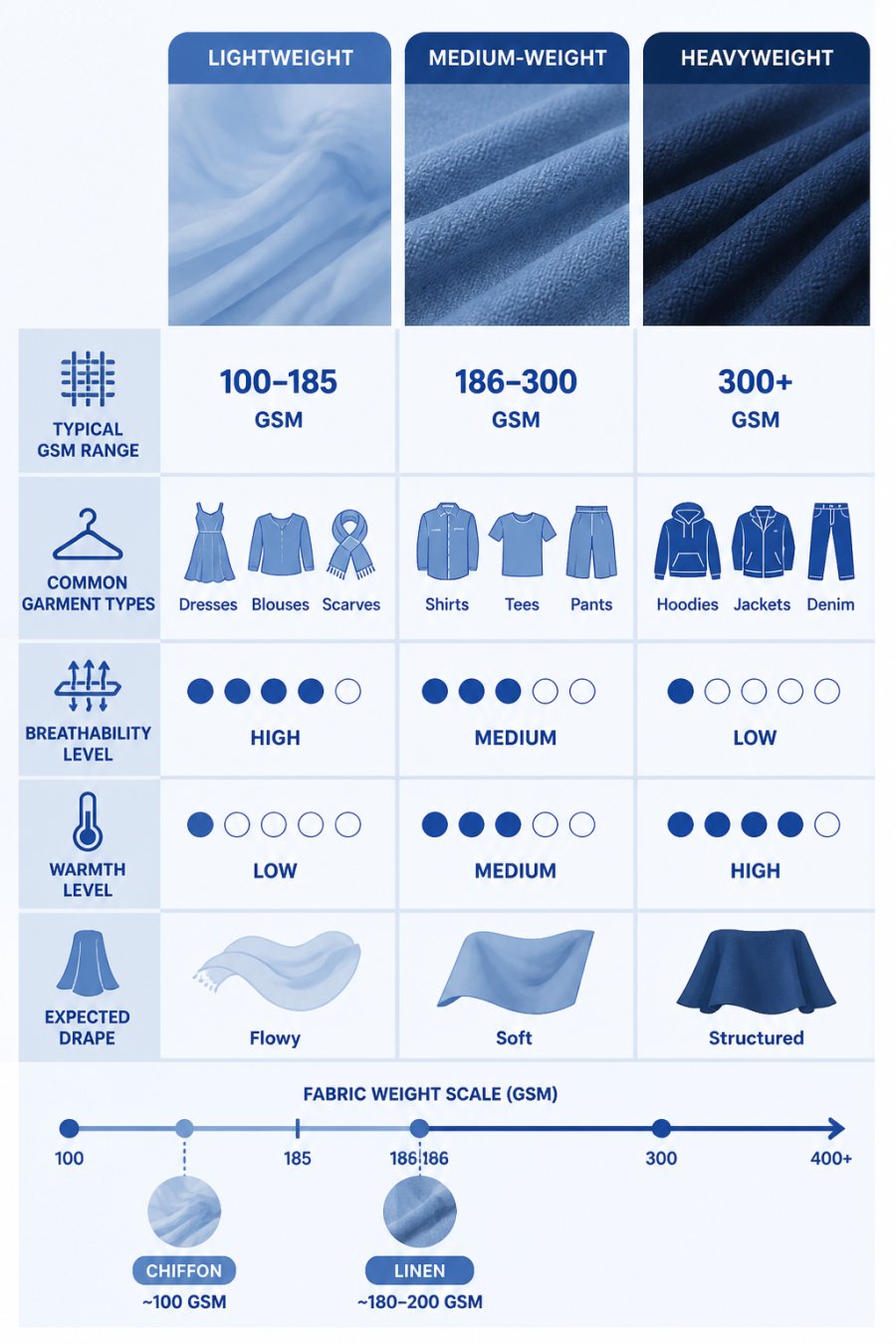
| Tier | Approx. GSM | Approx. oz/yd² | Typical Feel | Common Garments | Breathability | Drape |
|---|---|---|---|---|---|---|
| Lightweight | 30-150 | 0.9-4.4 | Airy, fluid | Chiffon dresses, summer blouses, lining | High | Soft, flowing |
| Medium-weight | 150-350 | 4.4-10.3 | Balanced, structured | Linen skirts, button-up shirts, midweight knits | Moderate | Holds some shape |
| Heavyweight | 350+ | 10.3+ | Dense, firm | Coats, heavy trousers, denim, outerwear | Low | Stiff, structured |
These ranges are approximate and overlap at the boundaries, a dense 140 GSM poplin can feel firmer than a loose 160 GSM jersey. Treat the numbers as a starting vocabulary, not a grade.
What Each Tier Looks Like in Real Fabrics
- Lightweight (roughly 30-150 GSM): chiffon, voile, gauze, lightweight jersey, lining fabrics. A chiffon ruffle wrap dress shows how that fluid drape works in practice.
- Medium-weight (roughly 150-350 GSM): linen shirting, poplin, oxford cloth, midweight cotton jersey, lighter twills.
- Heavyweight (roughly 350 GSM and up): denim, canvas, melton wool, heavy fleece, upholstery-weight twill. These bring warmth and structure, but they can feel stiff if the weave is tight.
When Lighter Fabric Outperforms Heavier Fabric
Weight is not a ranking. In several common cases, the lighter option is the better long-term buy:
- Hot, humid climates: a lightweight, breathable weave gets worn more often, and a garment that is actually worn beats one that hangs in the closet.
- Layering pieces: a lightweight base layer under a medium-weight shell handles temperature swings better than one heavy garment.
- High-movement garments: lightweight knits with good recovery move with the body; heavy stiff fabrics can crack at fold lines over time.
- Drape-dependent designs: flowing silhouettes need lighter cloth, a heavy fabric in the same cut would pull at seams and distort the shape.
Matching Tier to Garment Type
- Tees and casual knits: lightweight to medium-weight; heavier tees hold shape but can feel hot.
- Button-up shirts: medium-weight shirting holds a collar and resists wrinkling.
- Denim and workwear: heavyweight for abrasion resistance, but check seam construction.
- Knitwear: medium to heavy for warmth; lighter gauges layer better.
For warm-weather tops, a linen button-up blouse and a sleeveless linen blouse both lean on breathable natural fibers in the medium-weight range. A coordinating linen A-line skirt rounds out the same weight class. Pay attention to fiber composition too, since natural fibers breathe differently than synthetics at the same weight.
Does Heavier Fabric Last Longer? Separating Weight From Wear Resistance
No. Heavier fabric does not automatically last longer. This is the myth we hear most, and it leads people to buy dense, uncomfortable clothing expecting durability.
Longevity depends on several factors working together:
- Fiber composition: natural versus synthetic fibers wear differently; long-staple cotton and wool resist pilling better than short-staple versions.
- Yarn quality: longer fibers and tighter twist resist abrasion and fuzzing.
- Weave and knit structure: tight, balanced weaves resist tearing; loose knits snag and distort.
- Garment construction: stitching, seam type, and thread strength often decide when a garment fails.
A lightweight, well-made garment with strong seams can outlast a heavy, poorly stitched one. Weight is one variable, not the answer.
A Repeatable Wear-Test Checklist
Instead of trusting a "heavyweight" label, assess a garment against the failure points that actually end its life. Use this checklist before buying and again after the first few wears:
- Pilling: rub a sleeve or side panel against itself for a few seconds. If fuzz balls form quickly, the yarn is likely short-staple or loosely twisted. Check underarms and cuffs after wear, those are the first pilling zones.
- Abrasion: look at high-contact areas, inner thighs, seat, elbows, cuffs, and where a bag strap sits. Thinning or shine in these spots signals early wear.
- Seam stress: grasp the seam allowance on both sides and pull gently. If stitches gape or thread looks thin, the seam is a weak point. Check whether seams are single-stitched or reinforced with a flat-felled or double-stitched finish.
- Stitch density: count stitches per inch along a hem or side seam. Sparse stitching (roughly under 10 per inch on wovens) is a common failure predictor.
- Shape retention: stretch a knit panel and release it. Slow recovery or a bagged-out shape means the fabric will sag with wear.
- Colorfastness: rub a damp white cloth on an inconspicuous area. Dye transfer suggests fading with washing.
- Shrinkage risk: check the care label for pre-shrunk or garment-washed claims; untreated natural fabrics can shrink noticeably on the first hot wash.
Where Garments Actually Fail
Most clothing fails at predictable points:
- Seams split when stitching is weak or thread is thin.
- Pilling builds where friction hits, like underarms and cuffs.
- Abrasion wears through high-contact spots first.
- Shrinkage distorts shape after careless laundering.
- Elastic and knit recovery gives out at waistbands and cuffs before the fabric itself wears through.
Weight Versus Actual Longevity: A Buying Framework
Use weight as one input among several:
- If the garment will see heavy friction (denim, workwear, bags), favor heavier fabric and reinforced seams.
- If the garment will be washed often (tees, base layers), favor medium-weight knits with good recovery and colorfast dye.
- If the garment is a statement piece worn occasionally (a printed dress), favor construction and care over weight, a lighter, well-finished piece can last for years with proper handling.
- If the garment must drape, accept lighter weight and inspect seams and finishing more closely, since lighter cloth puts more stress on stitching.
Weight tells you mass, not yarn quality, weave density, or stitching. The checklist above tells you what weight cannot.
How to Choose Fabric Weight for Clothing by Season and Garment Type
Match weight to climate and to the garment's job. A summer blouse and a winter coat need opposite ends of the scale.
Consider this simple framework:
- Hot weather: go lightweight for breathability
- Cool weather: medium-weight adds warmth without bulk
- Cold weather: heavyweight traps heat and holds structure
- Tailored pieces: medium to heavy holds shape better
- Flowing pieces: lightweight gives movement and drape
For warm-weather tops, a linen button-up blouse and a sleeveless linen blouse both lean on breathable natural fibers. A coordinating linen A-line skirt rounds out the same weight class. Pay attention to fiber composition too, since natural fibers breathe differently than synthetics.


How to Care for Printed Garments Without Shortening Their Life
Care routines decide longevity as much as weight does. Printed and handcrafted pieces need gentler handling than plain fabrics.
Follow these habits:
- Wash cold to protect color and reduce shrinkage
- Turn prints inside out before laundering
- Skip harsh detergents that fade dyes
- Air dry whenever possible to protect shape
- Follow the care label exactly, especially for delicate fabrics
A lightweight printed piece may need hand washing, while a medium-weight linen can often take a gentle machine cycle. Match your routine to both weight and construction.
Cost Per Wear: The Real Measure of a Garment's Value
Cost per wear is the purchase price divided by the number of times you actually wear a piece. It reframes value around use, not sticker price.
A garment you wear often and keep for years beats a cheap piece that falls apart after a few washes.
Many slow-fashion shoppers find that fewer, better pieces lower their long-term spending. That is the case for choosing construction and fiber quality over a single GSM number.
Shop Limited-Edition Pieces Built to Be Worn for Years
Longevity starts with smart choices at the buying stage. Weight, fiber, construction, and care all work together, and no single number tells the whole story.
At Alana Kay Art, our limited-edition apparel is built from original artwork and commissioned illustrations, with bold color and thoughtful design in every piece. If you want to find more places to shop unique, lasting clothing, see our guide to the best spots for unique colorful clothing.
Durability is not about chasing the heaviest fabric on the rack. It is about matching weight to purpose and caring for what you own. Explore our linen button-up blouse and chiffon ruffle wrap dress to see how fabric choice shapes a garment.
Frequently Asked Questions
Does heavier fabric last longer than lighter fabric?
Not automatically. Heavier fabric often resists abrasion and holds its shape better, but longevity also depends on fiber composition, weave or knit structure, seam strength, and how the garment is washed. A tightly woven mid-weight linen can outlast a loosely knit heavyweight fabric that pills and stretches. Judge fabric weight alongside construction and care, not as a standalone guarantee of durability.
Which GSM is good for clothing?
There is no single good number because GSM should match the garment. Lightweight fabrics around 100 to 150 GSM suit chiffon dresses and summer blouses, medium-weight fabrics around 150 to 250 GSM work for most shirts, skirts, and dresses, and heavyweight fabrics above 250 GSM fit outerwear and structured pieces. For everyday wear, mid-weight fabric usually balances breathability, drape, and wear resistance best.
How can you tell if a garment's fabric will hold up to frequent washing?
Check the label for fiber composition and care instructions, then look at construction. Tight, even stitching, reinforced seams, and a fabric that springs back when stretched are good signs. Pilling, loose threads, or thin spots where light passes through easily suggest faster wear. Following the care label, such as dry cleaning chiffon or washing linen cold, matters as much as the fabric weight itself.
How do I care for printed garments so the print and fabric last?
Turn printed garments inside out, wash cold on a gentle cycle, and skip the dryer in favor of air drying. Avoid bleach and fabric softener, which can dull colors and break down fibers. For delicate prints on chiffon or similar fabrics, dry cleaning protects both the print and the drape. Storing pieces folded away from direct sunlight also slows fading and keeps colors bold.

Leave a comment