
What Are the Best Natural Fibers for Durable Clothing?
Last Updated: October 27, 2026
Quick Summary
Hemp and linen are the best natural fibers for durable clothing, offering very high to high abrasion resistance and tensile strength. Wool holds shape for many seasons with sparing washing, while cotton and silk wear faster. Match the fiber to the garment's job and check construction, since a flimsy weave fails regardless of fiber.
- Longer fibers generally make stronger yarns because fewer fiber ends need twisting together.
- A linen-cotton blend reduces linen's wrinkling while keeping its strength.
- Wool's natural lanolin resists odor, so airing between wears often replaces washing entirely.
- Woven plant-fiber fabrics like linen and hemp are straightforward to patch and darn.
- Turn garments inside out before washing to reduce surface abrasion.
Table of Contents
- What Makes a Natural Fiber Durable?
- The Most Durable Natural Fabric: A Quick Comparison
- Linen vs Cotton Durability: Which Holds Up Longer?
- The Best Wool for Clothing That Lasts
- Hemp, Silk and Specialty Fibers for Durable Clothing
- Fiber Blends and Construction: Why the Weave Matters
- How to Make Clothes Last Longer
- Choosing Durable Natural-Fiber Pieces for Your Wardrobe
- Frequently Asked Questions
What Makes a Natural Fiber Durable?
Durability in natural fibers comes down to three measurable properties: fiber strength, abrasion resistance, and how the fabric is constructed. A fiber with high tensile strength but a loose weave will still wear out fast. Bold design means nothing if the garment falls apart after a season.
Fiber strength measures how much pulling force a fiber withstands before it snaps. Abrasion resistance measures how well it handles friction from wear, washing, and rubbing against surfaces. Construction, the third factor, determines whether those fiber properties translate into a garment that lasts.
Fiber Strength, Abrasion Resistance and Construction
Longer fibers generally make stronger yarns because fewer fiber ends need to be twisted together. That is why long-staple cotton outperforms short-staple cotton, and why linen's naturally long flax fibers resist pilling.
Construction matters just as much.
Watch out: judging durability by fiber alone is the most common mistake. A cheap long-staple cotton tee with a thin, loose knit will wear through faster than a well-constructed linen-cotton blend.
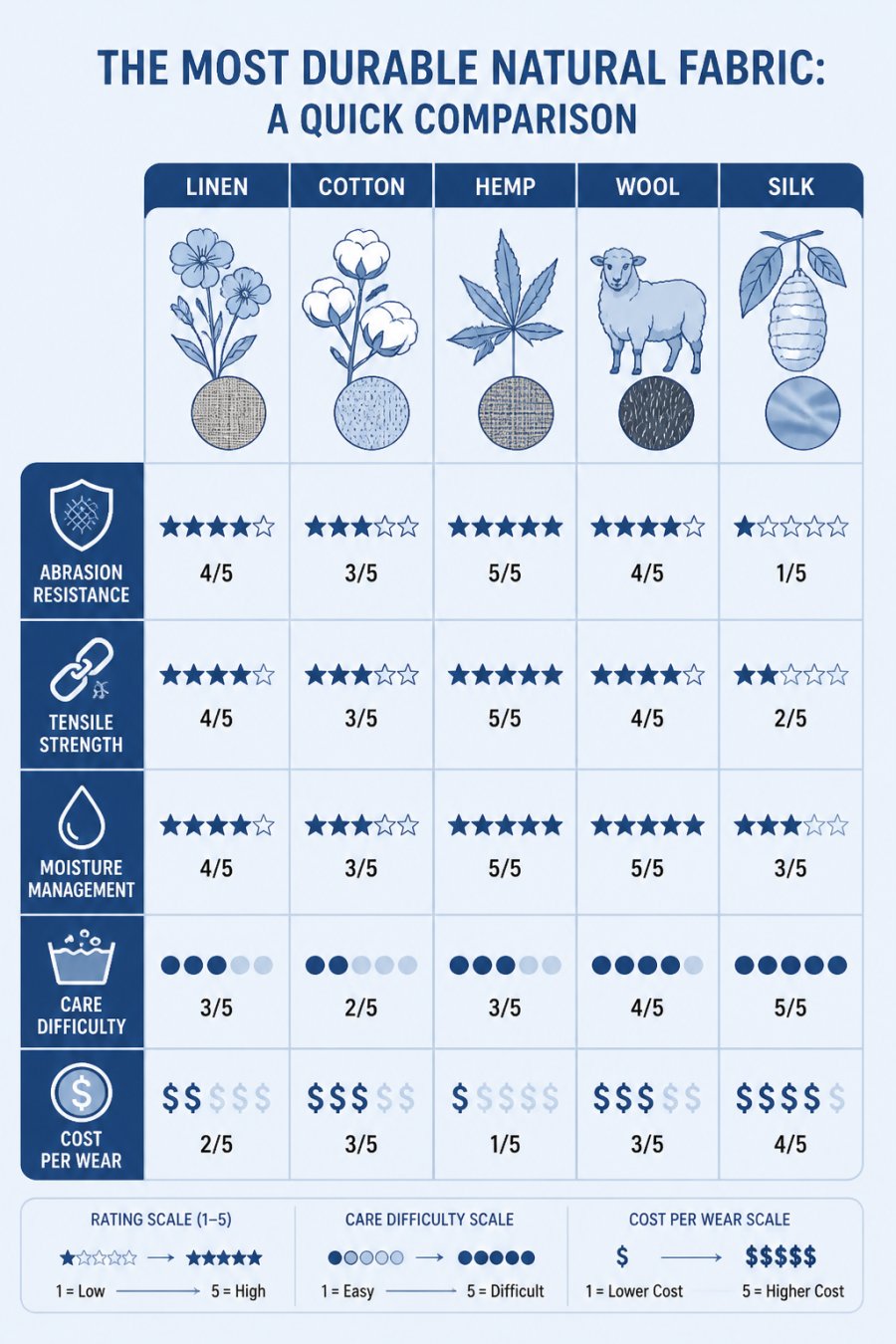
The Most Durable Natural Fabric: A Quick Comparison
| Fiber | Abrasion Resistance | Tensile Strength | Moisture Management | Care Difficulty | Relative Cost per Wear |
|---|---|---|---|---|---|
| Hemp | Very high | Very high | High | Moderate | Low over time |
| Linen | High | High (stronger wet) | Very high | Moderate | Low over time |
| Wool | High | Moderate | High | High (special care) | Medium |
| Cotton | Moderate | Moderate | Moderate | Easy | Medium |
| Silk | Low to moderate | Moderate | Moderate | High (dry clean) | High |
What the Tests Actually Measure
Abrasion resistance is typically tested with machines that rub fabric against a standard abrasive surface under controlled pressure, counting cycles until a hole forms or the fabric thins noticeably. Tensile strength measures the force required to break a strip of fabric, often reported in pounds per inch of width. Pilling is assessed by simulating friction and rating the number and size of fiber balls that form on the surface.
Expected Wear Life by Fiber
Rather than promising exact years, think in relative terms. A well-constructed hemp or linen garment worn and washed regularly will typically outlast a comparable cotton piece by a meaningful margin, while silk garments demand gentler wear schedules to avoid surface damage. Wool sweaters and suiting hold shape for many seasons when washed sparingly and stored properly. The practical move is to match the fiber to the garment's job: hemp and linen for hard-wearing everyday pieces, wool for structure and warmth, cotton for softness and easy care, and silk for low-friction, special-occasion wear.
The Blends That Beat Pure Fibers
Blending is where durability gets interesting. A linen-cotton blend reduces linen's wrinkling while keeping its strength. A wool-nylon blend improves abrasion resistance in high-friction areas like elbows and cuffs. A silk-cotton blend adds structure to silk's drape. None of these blends is inherently "better" than a pure fiber, but each solves a specific weakness. When you compare garments, read the fiber percentages and ask what problem the blend is solving, that tells you more than the fiber name alone.
Linen vs Cotton Durability: Which Holds Up Longer?
If you want a piece that combines both fibers, browse our linen cotton pieces.
The Best Wool for Clothing That Lasts
Watch out: washing wool in hot water or drying it in a machine causes shrinkage and fiber damage that cannot be reversed. Cold hand-washing and flat drying protect the fibers.
Hemp, Silk and Specialty Fibers for Durable Clothing
Silk shines in blends. Our silk cotton wild rag scarf, a 30% silk and 70% cotton square, shows how blending lets silk's luster and drape coexist with cotton's strength and breathability.
Fiber Blends and Construction: Why the Weave Matters
The lesson: read the fiber composition and look at the fabric itself. A 100% linen garment in a flimsy weave will not outlast a well-made blend.
How to Make Clothes Last Longer
The single biggest factor in garment longevity is how you wash and store it, not just what fiber it is made from. Care habits can add years to a well-made piece, and fiber-specific care matters more than most shoppers realize.
Fiber-Specific Care
Linen softens with every wash and actually gains strength when wet, so it tolerates frequent laundering better than most fibers. Wash in cool or warm water on a gentle cycle, avoid overloading the machine, and remove promptly to reduce wrinkles. Linen can shrink on the first wash, especially in hot water, so expect some initial tightening and size accordingly. Tumble dry on low only if you want a softer hand; air drying preserves shape and extends life.
Cotton is easy to launder but vulnerable to shrinkage and pilling under heat and friction. Wash in cold water, turn garments inside out to reduce surface abrasion, and air dry when possible. Short-staple cotton pills faster than long-staple, so treat pilling as a signal of fiber quality as much as care habits.
Wool needs the most discipline. Hot water and machine drying cause irreversible shrinkage and fiber damage. Cold hand-washing or a wool cycle with a pH-neutral detergent, then flat drying, protects the fibers. Wool's natural lanolin resists odor, so airing between wears often replaces washing entirely. Store folded, not hung, to avoid shoulder stretch.
Hemp is tough but benefits from gentle cycles and air drying to preserve its texture. It resists UV damage and holds up to frequent washing, though repeated high heat can weaken fibers over time.
Silk is the most care-sensitive: dry cleaning is safest for pure silk, and direct sunlight, sweat, and friction degrade the surface. Store away from light and avoid hanging heavy silk pieces for long periods.
Stain Treatment by Fiber
Act fast and blot, never rub. For plant fibers like cotton, linen, and hemp, cool water and a mild detergent handle most fresh stains. Wool and silk are protein fibers, so avoid hot water and harsh alkaline detergents that can damage the fiber surface; use cool water and a gentle wool-safe cleaner. When in doubt, test any treatment on an inside seam first.
Repairability: The Overlooked Durability Factor
A garment's lifespan depends as much on how easily it can be repaired as on how it wears. Woven plant-fiber fabrics like linen and hemp are straightforward to patch and darn because the weave structure accepts stitching well. Wool takes to darning and reweaving, and a good tailor can reinforce high-wear areas like elbows and cuffs before they fail. Silk is harder to repair invisibly, which is one reason it suits lower-friction garments. Learn basic darning and seam repair, or build a relationship with a tailor, early fixes are far cheaper than replacement.
Washing and Storage Habits
- Wash less often. Spot-clean and air garments between wears when possible.
- Turn garments inside out before washing to reduce surface abrasion.
- Use cold water and gentle cycles to protect fibers from heat damage.
- Air dry when you can. Tumble drying breaks down fibers and causes shrinkage.
- Store folded or on padded hangers to prevent stretching and shoulder marks.
- Repair early. Fix a loose seam or small hole before it becomes a tear.
- Rotate your wardrobe so no single piece takes constant wear.
Follow the FTC care label guidance on each garment, since care instructions are designed around the specific fiber and construction.
Choosing Durable Natural-Fiber Pieces for Your Wardrobe
Our button-up linen blouse and elastic waist A-line linen skirt are made from a linen-cotton blend.


Textile Exchange's fiber and materials guidance is a useful reference for understanding how fibers are sourced and produced. Pair that knowledge with care habits, and your natural-fiber wardrobe will reward you for years.
Frequently Asked Questions
What is the most durable natural fiber for clothing?
Hemp and linen lead on tensile strength and abrasion resistance, which is why both show up in durable clothing meant to be worn hard. Wool follows closely for resilience and shape recovery, especially in knits and outerwear. Cotton is softer and cheaper but wears faster at high-friction points like cuffs and knees. The fiber only sets the ceiling: weave density, thread count and seam construction decide how long a garment actually lasts.
Is linen more durable than cotton?
The Alana Kay Art collection includes linen-cotton pieces.
Does wool last longer than cotton?
Wool typically outlasts cotton in garments worn repeatedly, because its fibers bend and recover rather than flatten. Merino is the best wool for clothing worn against the skin: fine, breathable and resistant to odor, so it needs washing less often. Coarser wools suit outerwear. Cotton wins on price and easy care, so the right choice depends on how often you plan to wear the piece.
How should you wash natural-fiber clothing to make it last longer?
Wash less often, use cold water and skip the dryer. Heat and agitation are what break down fibers fastest. Turn garments inside out, use a gentle cycle and lay knits flat to dry so they keep their shape. Silk and structured wool usually need dry cleaning, as noted on the silk-cotton Wild Rag Scarf. Storing pieces folded rather than on hangers also prevents shoulder stretch in knits.
Are natural fibers more durable than synthetic fabrics?
Not always on raw strength: polyester and nylon resist abrasion well. Natural fibers win on longevity of appearance. They resist pilling and odor, take dye deeply and can be repaired or tailored. Synthetics shed microplastics and tend to hold onto smells. For durable clothing you want to keep for years, natural fibers plus good construction usually beat a cheap synthetic garment replaced every season.
Building a wardrobe of durable natural fibers takes intention, and finding pieces that are both lasting and expressive is the hard part. At Alana Kay Art, we create limited-edition apparel from original artwork and thoughtful design, using natural fiber blends that hold up to real life. Our pieces are made to be collected and worn, with bold color that stands out and construction that lasts. Get started with Alana Kay Art and build a wardrobe of wearable art you will keep for years.

Leave a comment