7 Best Fabrics for Vibrant Printed Clothing That Last
Last Updated: October 29, 2026
Quick Summary
The best fabrics for vibrant printed clothing are 100% cotton jersey for deep, soft-edged color in everyday tees, and polyester satin or crepe for the brightest, most durable direct-to-garment prints on drapey styles. Silk offers unmatched depth but fades fastest in the wash, while linen-cotton blends breathe best for warm days.
- Cotton jersey absorbs pigment into the fiber, making it the standard choice for screen and direct-to-garment printing.
- Polyester satin scores 5 for vibrancy and wash-fastness but only 1 for breathability.
- Silk is the least wash-fast fabric on the list; dry cleaning protects its color best.
- Dye-sublimation suits power mesh because the color becomes part of the fiber and stretches without cracking.
- Wash cold and inside out, and air-dry stretch synthetics to protect prints from chlorine and heat.
Table of Contents
- Why Fabric Choice Decides How Vibrant a Print Looks
- Quick Comparison: Fabrics Ranked by Print Vibrancy
- 1. 100% Cotton Jersey: The Best Fabric for Custom Printed Shirts
- 2. Polyester Satin and Crepe: The Best Fabric for Direct-to-Garment Printing on Drapey Styles
- 3. Silk and Silk-Cotton Blends: Depth of Color With a Luxurious Hand Feel
- 4. Linen-Cotton Blends: Breathable Prints for Warm Days
- 5. Power Mesh and Stretch Blends: Print Clarity on Bodycon Silhouettes
- Cotton vs Polyester for Printing: Which Holds Color Better
- Frequently Asked Questions
Why Fabric Choice Decides How Vibrant a Print Looks
The fabric is the print. That single idea explains why two shirts can carry the same artwork and look nothing alike. One comes back from the wash bright and crisp; the other goes chalky and dull after a month.
Fiber chemistry drives everything. Cotton Incorporated's fiber and fabric research documents how cellulose fibers absorb dye and pigment into the fiber structure, while synthetic fibers hold color at or near the surface. Surface color scuffs, cracks and fades faster. Absorbed color stays.
Below, fabrics are ranked by print performance first, then comfort, to help you compare them.
Quick Comparison: Fabrics Ranked by Print Vibrancy
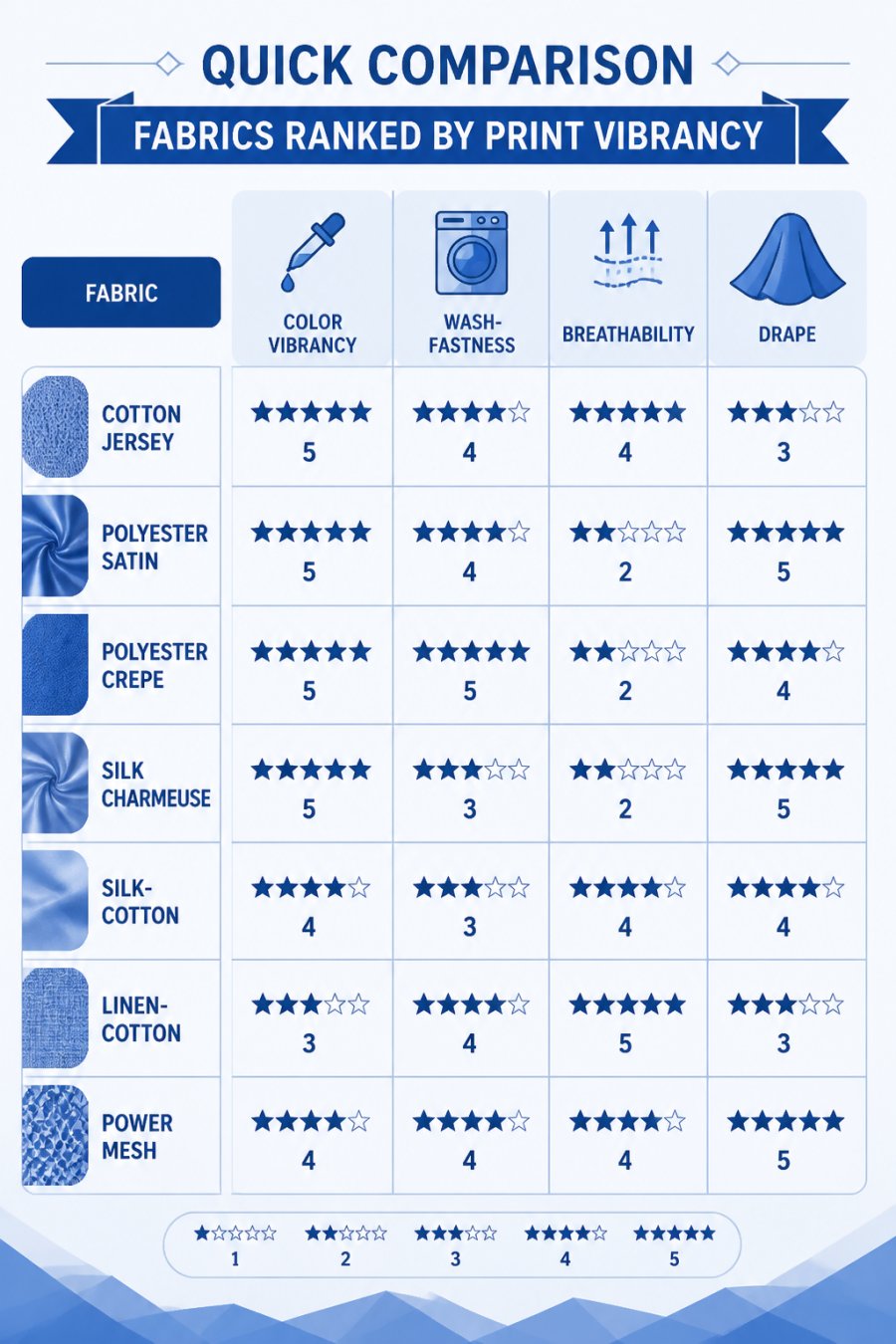
Six fabrics matter most for printed apparel. This table scores each on color vibrancy, wash-fastness, breathability and drape, on a 1-5 scale.
| Fabric | Color Vibrancy | Wash-Fastness | Breathability | Drape |
|---|---|---|---|---|
| 100% cotton jersey | 5 | 4 | 4 | 3 |
| Polyester satin | 5 | 5 | 1 | 5 |
| Polyester crepe | 4 | 5 | 2 | 4 |
| Silk charmeuse | 5 | 3 | 3 | 5 |
| Silk-cotton blend | 4 | 3 | 4 | 4 |
| Linen-cotton blend | 3 | 4 | 5 | 3 |
| Power mesh | 4 | 4 | 4 | 5 |
The trade-off is visible at a glance. No fabric wins every column. Polyester satin leads on vibrancy and durability but fails on breathability. Linen-cotton breathes best but softens print edges. Choose by the garment, not by the chart alone.
1. 100% Cotton Jersey: The Best Fabric for Custom Printed Shirts
Cotton jersey is the best fabric for custom printed shirts because its knit structure absorbs pigment into the fiber, producing deep, soft-edged color that feels like part of the cloth. It is the standard choice for screen printing and direct-to-garment printing alike.
The catch is shrinkage and slight fading over many washes. Pre-shrunk, combed cotton limits both. Our linen-cotton blouse shows how natural fibers carry bold color when the print method suits the cloth.
Best for: everyday printed tees and casual tops. Skip if: you need sharp photographic detail across large areas.
2. Polyester Satin and Crepe: The Best Fabric for Direct-to-Garment Printing on Drapey Styles
Polyester takes the best fabric for direct-to-garment printing crown on smooth, drapey styles. DTG inks bond to polyester fibers with a bright, crisp result, and satin's sheen amplifies color saturation. Crepe adds texture that softens the finish slightly but keeps color strong.
The drawback is heat. Polyester traps warmth, so these pieces suit evenings and cooler days more than summer afternoons. Our satin button-up blouse puts that print vibrancy on full display in a magenta palette.

Best for: statement blouses and draped silhouettes. Skip if: you run hot or want an all-day summer fabric.
3. Silk and Silk-Cotton Blends: Depth of Color With a Luxurious Hand Feel
Silk absorbs dye into its protein fibers, giving prints a depth and luster that few fabrics match. Silk-cotton blends soften the care burden while keeping most of that richness, though both need gentle handling.
Watch out: silk is the least forgiving fabric here on wash-fastness. Dry cleaning protects the color, and machine washing dulls it faster than any other fabric in this list. Our silk-cotton Wild Rag scarf shows the blend's printed depth in a wearable accessory.

Best for: scarves, blouses and collectible pieces. Skip if: you want low-maintenance laundry.
4. Linen-Cotton Blends: Breathable Prints for Warm Days
Linen-cotton blends bring breathability to printed clothing, and the cotton content helps ink hold better than pure linen would. Prints come out slightly softer at the edges, which suits painterly and floral prints more than fine geometric ones.
The blend resists fading reasonably well and feels cooler than any synthetic on this list. Browse the limited-edition linen collection to see how bold prints read on breathable cloth.
Best for: warm-weather blouses and relaxed fits. Skip if: you want razor-sharp print detail.
5. Power Mesh and Stretch Blends: Print Clarity on Bodycon Silhouettes
Power mesh holds print clarity on bodycon silhouettes because its dense, stretchy knit keeps the print from distorting as the garment moves. That is the short version. The useful version explains why, because stretch fabrics are where printed clothing most often fails.
Wild Rag Scarf Square - Silk Cotton →
What power mesh actually is
Power mesh is a synthetic knit, usually nylon or polyester with a high elastane content, engineered to stretch in multiple directions and recover its shape. The dense, fine-gauge construction gives ink a smooth, even bed, which is why prints on power mesh look sharper than prints on open-hole mesh or loose athletic knits. The trade-off is breathability: dense mesh traps heat compared with cotton jersey, so it suits fitted statement pieces more than all-day summer wear.
Why stretch breaks prints, and how to prevent it
A print is a film sitting on a fabric. When the fabric stretches, the film must stretch with it or it cracks, whitens at the stress lines, or distorts the artwork. The failure is most visible across hips, bust, and knees, where a bodycon garment stretches most.
Three practices reduce it:
- Match ink to stretch. Dye-sublimation is the best fit for power mesh and other high-elastane synthetics because the color becomes part of the fiber rather than a film on top, so it stretches without cracking. Water-based DTG inks on stretch synthetics need a stretch additive or they will crack at the first wear.
- Test under tension. Print a swatch, stretch it to the garment's maximum wear tension, and hold it there. If the print whitens or the edges feather, the ink or the fabric is wrong for the silhouette.
- Account for pattern distortion. A geometric or striped print on a stretch panel will bow and curve when worn. Either design for that distortion or choose allover prints and small-scale motifs that hide it.
Stretch blends beyond power mesh
Cotton-elastane jersey (often 95/5) is the everyday stretch option: it prints well with screen and DTG, feels soft, and recovers shape, but the elastane content means the print must tolerate moderate stretch. Polyester-spandex athletic knits behave like power mesh but with more breathability, making them the better choice for activewear prints. Nylon-spandex is the most durable of the group and the most common base for swimwear, where chlorine and salt water are the real test.
Our short mesh dress with ruching demonstrates how mesh keeps a print sharp across a fitted silhouette.

Best for: bodycon dresses, swimwear, activewear, and layering tops. Skip if: you prefer loose, unstructured fits or need maximum breathability.
Cotton vs Polyester for Printing: Which Holds Color Better
Polyester holds color better over time; cotton prints with richer depth up front. That is the honest answer to cotton vs polyester for printing, but it is only the headline. The full answer depends on three variables that most guides collapse into one: the fiber, the fabric construction, and the print method. Change any one and the ranking flips.
How fiber chemistry sets the ceiling
Cotton is cellulose. Its fibers are porous and absorbent, so dye and pigment penetrate the fiber rather than sitting on top of it. That is why cotton prints look soft-edged and deep rather than glossy. Polyester is a petroleum-based synthetic with a smooth, non-porous surface. Water-based inks bead on it, which is why polyester almost always requires a pretreatment or a heat-based process to accept color.
The practical consequence: cotton rewards inks that soak in, polyester rewards inks that bond or sublimate. Choose the method to match the fiber, not the other way around.
Method-by-method: which fiber wins
- Direct-to-garment (DTG): Polyester wins on brightness and fine detail because the ink sits on the surface and reflects light; cotton wins on softness and breathability because the ink merges with the fiber. On 100% cotton, DTG output looks slightly muted next to polyester but feels like part of the shirt. On polyester, DTG can look photographic but may feel slightly plasticky.
- Screen printing: Cotton wins clearly. Plastisol inks mechanically lock into cellulose fibers and survive repeated washing; on polyester they can crack or peel because the ink cannot anchor to the smooth surface. Water-based screen inks on cotton produce the softest hand feel of any method.
- Dye-sublimation: Polyester only. The process turns solid dye into gas and drives it into the synthetic fiber, so the color becomes part of the cloth. Cotton cannot accept sublimation dye at all, which is why sublimated apparel is always synthetic or synthetic-blend.
- Heat transfer and vinyl: Blends and polyester tolerate the heat better; 100% cotton can scorch under high heat, so lower-temperature transfers are safer on cotton.
Construction matters as much as fiber
A 100% cotton jersey knit and a 100% cotton woven poplin print very differently. Knits stretch, so the ink film must stretch with them or it cracks. Wovens are dimensionally stable, so prints stay sharp but the fabric may feel stiffer.
Blends split the difference. A 50/50 cotton-polyester jersey accepts screen print better than pure polyester and feels softer than pure cotton, which is why it is common in promotional apparel. A 60/40 cotton-polyester tends to favor cotton-like hand feel; a 35/65 favors polyester-like durability.
Long-term color retention
Polyester resists fading longer because the color is locked into or bonded onto a fiber that does not swell and shrink the way cotton does. Cotton prints soften gradually as the ink film abrades in the wash.
If you want to know how to prevent printed clothes from fading, start with fiber choice, then wash cold and inside out. The American Cleaning Institute's fabric care guidance covers temperature and detergent basics that protect color.
Frequently Asked Questions
What fabric is best for vibrant clothing prints?
The catalog includes a silk-cotton Wild Rag scarf, a silk charmeuse Wild Rag scarf, and linen-cotton blouses.
Does polyester hold color better than cotton?
The catalog lists a satin button-up blouse and a chiffon blouse, but does not provide comparative information about how polyester and cotton hold color.
Is cotton or polyester better for printed shirts?
The catalog includes a satin button-up blouse and a mesh top, but does not provide comparative information about cotton and polyester for printed shirts.
How can I keep printed clothing from fading?
The silk charmeuse Wild Rag scarf is dry clean only.
What should I look for when buying printed fabric by the yard?
Check the fiber content first, then the fabric weight and density, because a tighter weave holds print detail more crisply than a loose one. Ask which print method the mill recommends: direct-to-garment for cotton and cotton blends, dye-sublimation for polyester. Request a swatch to test hand feel, drape and stretch before committing to yardage. Deadstock fabric can be a good value, but confirm the fiber content and inspect for flaws before you cut.
The right fabric makes a print last, and the right print makes a fabric worth wearing. If you want pieces where bold color and thoughtful design meet quality construction, Alana Kay Art builds limited-edition apparel from original artwork, with bold palettes and fabrics chosen for how they print. Explore the shop to find your next statement piece, and get started with Alana Kay Art today.

Leave a comment