
7 Ways to Build a Capsule Wardrobe for Beginners: A Step-by-Step Guide
Last Updated: November 3, 2026
Quick Summary
To build a capsule wardrobe for beginners, start with a closet audit and declutter, then define your personal style and lifestyle needs before choosing a coordinating color palette. Build a versatile base of essential pieces, use a checklist to stay on track, and plan outfits so a small curated set mixes and matches across seasons and occasions.
- Empty your closet and sort items into keep, repair, donate, and toss piles.
- Write down your typical week so your capsule reflects how you actually dress.
- Use two or three neutrals as your base plus two or three accent colors.
- A beginner capsule of 30-40 items is a common starting range, not a rule.
- Check fabric content, construction, and versatility before buying any piece.
Table of Contents
- 1. Start With a Closet Audit and Declutter
- 2. Define Your Personal Style and Lifestyle Needs
- 3. Choose a Color Palette That Works for You
- 4. Build a Versatile Base Wardrobe of Essential Pieces
- 5. Use a Capsule Wardrobe Checklist to Stay on Track
- 7. Study Capsule Wardrobe Examples and Plan Your Outfits
- Shop the Alana Kay Art Capsule Collection
- Frequently Asked Questions
1. Start With a Closet Audit and Declutter
The fastest way to build a capsule wardrobe for beginners is to empty your closet and look at what you actually wear. Pull everything out, sort it into keep, repair, donate, and toss piles, and count how many pieces you reach for weekly. Most people find that a small fraction of their clothes gets regular use.
This step matters more than shopping. A capsule wardrobe is a small, curated set of versatile pieces that mix and match across seasons and occasions. You cannot curate what you have not seen.
Here is how we would run the audit in one afternoon:
- Empty the entire closet onto the bed
- Set aside anything unworn in the past 12 months
- Separate damaged items for repair or donation
- Group what remains by category: tops, bottoms, layers, dresses, shoes
- Note gaps on paper before buying anything new
Watch out: Do not declutter in a rush and toss pieces you love but rarely wear. Some items are seasonal or occasion-specific, and they earn their place.
2. Define Your Personal Style and Lifestyle Needs
Personal style is the set of colors, cuts, and fabrics you reach for without thinking. Lifestyle needs are the practical demands of your week: how many days you dress for an office, how often you are casual, and whether you need pieces for events.
Write down your typical week. If four days are workdays and three are casual, your capsule should reflect that split. A wardrobe built for a life you do not live will sit unworn.
Ask yourself three questions:
- What three outfits make you feel most confident?
- What do you actually do in a normal week?
- Which fabrics do you avoid because they itch, wrinkle, or cling?
If you want more color and personality in your base pieces, our guide to where to buy unique colorful clothing covers shops worth knowing as you define your look.
3. Choose a Color Palette That Works for You
A color palette is a small set of colors that all coordinate with each other. Most beginners do best with two or three neutral colors as the base and two or three accent colors for interest.
Neutral colors do the heavy lifting: black, navy, cream, gray, camel, olive. Accent colors add personality. The test is simple. Hold any two pieces from your palette side by side. If they work together, the palette is doing its job.
| Palette Role | Examples | How Many Pieces |
|---|---|---|
| Core neutrals | Black, navy, cream, gray | 60-70% of capsule |
| Secondary neutrals | Camel, olive, denim blue | 15-20% of capsule |
| Accents | Magenta, rust, emerald | 10-15% of capsule |
Bold color works in a capsule when it is deliberate. One statement piece in a strong print can anchor several neutral outfits.
4. Build a Versatile Base Wardrobe of Essential Pieces
A base wardrobe is the foundation layer of your capsule: the tops, bottoms, and layers you wear most often. Start with quality clothing you can wash and rewear, then add personality.
Our picks for a beginner base:
- A reversible bomber jacket in satin that gives you two looks from one piece and layers year-round
- Straight leg pants with pockets in satin with an elastic waist for comfort on long days
- A linen button-up blouse that breathes and transitions from weekend to weekday
These three pieces alone create multiple outfit combinations. Add a simple tee, a knit sweater, and one pair of well-fitting denim, and you have the skeleton of a working capsule.
Straight Leg Pants with Pockets →


Watch out: Do not buy five versions of the same top. Variety in category, not quantity in one category, is what makes a capsule function.
5. Use a Capsule Wardrobe Checklist to Stay on Track
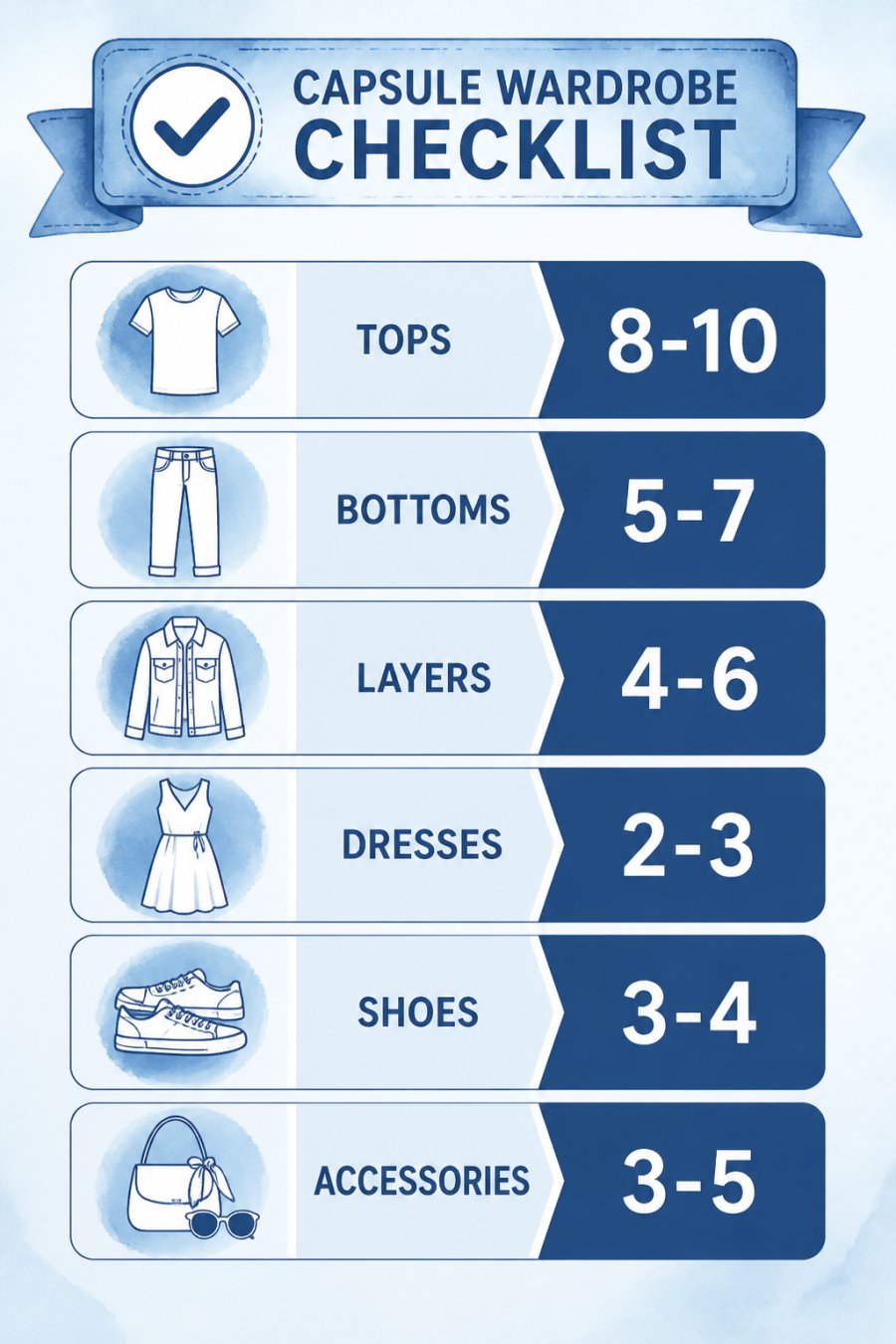
A capsule wardrobe checklist is a written list of categories and piece counts that keeps you from overbuying. For a beginner capsule of 30-40 items, a common breakdown looks like this.
7. Study Capsule Wardrobe Examples and Plan Your Outfits
Capsule wardrobe examples show how a small set of pieces produces a large number of outfit combinations.
A repeatable planning method:
- Photograph each capsule piece flat on a plain background
- Build five complete outfits from those photos
- Note which pieces appear most often
- Fill gaps only where an outfit fails
An outfit matrix is one step that separates a capsule that works from one that stalls. Build a simple grid with your tops down one side and your bottoms across the top.
A practical target is three to five marked combinations per top and per bottom. That is enough to get through a week without repeating an outfit and enough to justify the space the piece takes up. Run the matrix before you buy anything new, then run it again after a purchase to confirm the new piece actually added combinations rather than duplicating one you already had.
Accessories stretch a capsule furthest. A silk charmeuse wild rag scarf adds color and texture to a neutral outfit and works tied at the neck, on a bag, or in hair.
Measure whether the capsule is working with three simple numbers. Cost per wear is the price of a piece divided by the number of times you have worn it; a $90 jacket worn 60 times costs $1.50 per wear, while a $30 top worn twice costs $15 per wear. Usable outfit count is the number of marked cells in your matrix. Unworn-item count is how many capsule pieces you have not touched in 30 days.
Maintain the capsule with a seasonal rotation. The Ellen MacArthur Foundation's work on circular fashion outlines why keeping clothing in use longer reduces waste, and the Environmental Protection Agency's facts and figures on textiles in municipal waste shows how much clothing ends up discarded each year.
Watch out: Do not rebuild the capsule from scratch each season. Rotate pieces in and out, keep the matrix, and change only what the wear counts tell you to change.
Shop the Alana Kay Art Capsule Collection
Building a capsule that feels like you, not a uniform, is the real challenge. At Alana Kay Art, we design limited-edition apparel from original artwork and commissioned illustrations, so your base pieces carry bold color and personality instead of blending in. Our satin reversible bomber jacket gives you two prints in one layer, our straight leg pants pair comfort with a polished drape, and our linen button-up blouse moves from weekday to weekend. Each piece is designed to be collected and worn, not replaced next season. Get started with Alana Kay Art and build a capsule wardrobe that looks unmistakably like you.
Frequently Asked Questions
What is the 3-3-3 rule for a capsule wardrobe?
The 3-3-3 rule is a simple starting framework: choose three tops, three bottoms, and three pairs of shoes that all work together. That gives you 27 possible outfit combinations from just nine pieces. It is a low-pressure way for beginners to test whether a capsule wardrobe approach fits their lifestyle before committing to a larger closet edit. Once you see how far nine pieces stretch, adding layers and accessories feels less overwhelming.
How can a beginner start a capsule wardrobe without spending a lot of money?
Start by shopping your own closet. Pull out the pieces you already wear most and build your first capsule around them. Fill gaps slowly, one or two items at a time, and prioritize versatile pieces like straight-leg pants or a button-up blouse that work across multiple outfits. Thrift stores, clothing swaps, and end-of-season sales stretch your budget further. The goal is intentional buying, not a single expensive shopping spree.
How many items should be in a beginner's capsule wardrobe?
Most beginners do well with 30 to 40 items, including shoes but excluding underwear, workout clothes, and pajamas. That count gives you enough variety for a full season without overwhelming your closet or your decision-making each morning. You can start smaller with the 3-3-3 rule and expand once you understand which pieces you actually reach for. There is no universal number; your lifestyle and climate should guide the final count.
What is the difference between a capsule wardrobe and a minimalist wardrobe?
A capsule wardrobe is a curated, seasonal collection of interchangeable pieces, often 30 to 40 items, designed to maximize outfit combinations. A minimalist wardrobe is a broader lifestyle choice focused on owning fewer things overall, with no fixed piece count. You can have a capsule wardrobe with bold, colorful statement pieces and still be minimalist in your buying habits. The capsule is a planning tool; minimalism is a mindset.
How do I choose a color palette for my capsule wardrobe?
Start with two or three neutral colors you already love wearing, such as black, navy, cream, or olive, then add one or two accent colors that make you feel confident. Hold your existing clothes up to the palette and notice which pieces you reach for most. A tight palette is what makes mix and match dressing effortless, because nearly every top works with nearly every bottom. Test the palette against your skin tone in natural light before you buy anything new.

Leave a comment